Cross Border Payments for Exporters and Importers: A Practical Guide
Introduction
Cross-border payments are an important part of international trade, whether a business is receiving money from overseas customers or paying international suppliers.
For exporters and importers, moving money between countries involves more than simply sending or receiving funds. Businesses also need to manage currencies, payment methods, exchange rates, transaction costs, settlement times, documentation, and compliance requirements.
A reliable payment process can make international trade easier. A poorly managed one can lead to delayed settlements, higher costs, payment failures, and reconciliation issues.
Here is what exporters and importers should know about managing cross border payments.
What Are Cross Border Payments?
A cross border payment is a transaction where the payer and recipient are located in different countries. For example, an Indian exporter selling products to a customer in the UAE needs to receive payment from the UAE. Similarly, an Indian importer purchasing products from a supplier in Germany needs to send payment to Germany.
Depending on the transaction, payments can move through banks, payment providers, card networks, local payment methods, or other financial institutions.
The payment route can affect the cost, processing time, currency conversion, and documentation involved.
How Cross Border Payments Work for Exporters
For exporters, the primary challenge is receiving international payments and converting them into usable funds in the business’s local account.
A typical flow looks like this:
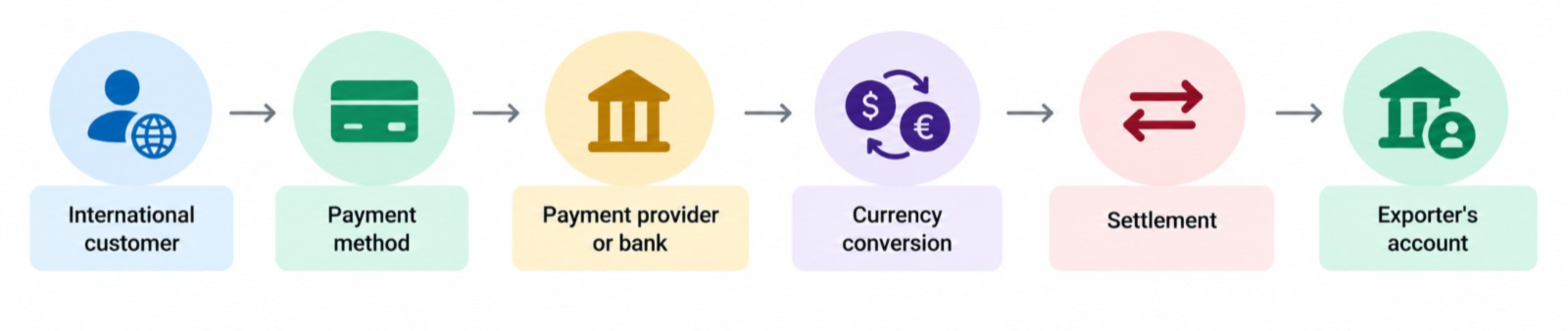
Exporters need to consider several factors before choosing a payment setup.
1. Payment method availability
Customers in different markets prefer different ways to pay. A customer in one country may prefer cards, while another may use a bank transfer or a local payment method.
Offering familiar payment options can make it easier for international customers to complete transactions.
2. Currency management
Exporters may receive payments in USD, EUR, GBP, AED, and other currencies.
Currency conversion can affect the final amount received, especially when exchange rates and conversion fees vary between providers.
3. Settlement timelines
A payment being successfully completed does not always mean the money is immediately available to the exporter.
Settlement timelines can vary depending on the payment method, currency, country, and financial institutions involved.
4. Documentation and reconciliation
Exporters need to maintain accurate records of international payments and connect them with invoices and export transactions.
This becomes more difficult when payments come through multiple providers or bank accounts.
How Cross Border Payments Work for Importers
Importers face a slightly different challenge. Instead of receiving money from international customers, they need to make payments to overseas suppliers. A typical flow looks like this:
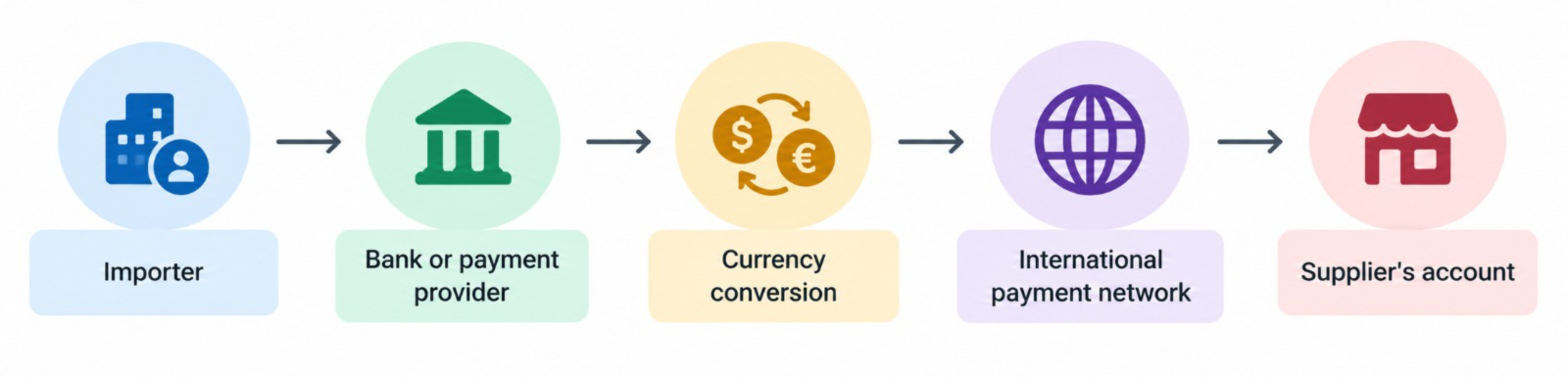
For importers, payment timing and cost can have a direct impact on supply chain operations.
A delayed payment could affect when a supplier releases goods, while unexpected currency conversion costs can increase the overall cost of the purchase.
Importers should therefore consider:
1. Payment processing time
2. Supported currencies
3. Exchange rates
4. Transaction fees
5. Supplier payment requirements
6. Payment tracking
7. Compliance and documentation
Common Challenges for Exporters and Importers
While exporters receive international payments and importers generally send them, both face several common challenges.
1. High transaction costs: International payments can involve processing fees, currency conversion charges, and other costs. Small differences can become significant when payment volumes increase.
2. Payment delays: Cross border transactions can pass through multiple financial institutions. This can make settlement slower than domestic payments.
3. Payment failures: A payment may fail because of incorrect account details, unsupported currencies, compliance checks, insufficient information, or issues with the payment route.
4. Currency fluctuations: Exchange rate movements can change the value of a payment between the time an invoice is created and when the transaction is settled.
5. Manual reconciliation: When businesses use multiple banks and payment providers, matching transactions with invoices and settlement records can become a time consuming finance task.
What Should Businesses Look for in a Cross Border Payment Setup?
The right payment infrastructure depends on the business model, countries served, transaction volumes, and preferred payment methods.
However, exporters and importers should look for a setup that provides:
1. Multiple payment options
Access to cards, bank transfers, local payment methods, and other relevant options can help businesses serve customers and suppliers across different markets.
2. Multi currency support
Businesses operating internationally need the ability to accept or send payments in the currencies relevant to their markets.
3. Transparent pricing
Understanding processing fees, currency conversion costs, and settlement charges helps businesses calculate the actual cost of each transaction.
4. Payment tracking
Finance and operations teams should be able to track payments from initiation to settlement without relying on multiple disconnected systems.
5. Automated reconciliation
Automated reconciliation can reduce manual work by matching payment and settlement information with invoices and transaction records.
6. Strong compliance controls
International transactions need to meet applicable regulatory and compliance requirements. Businesses should work with payment partners that have appropriate controls and processes in place.
How Payment Orchestration Can Help
Businesses operating across multiple countries may work with several payment providers, banks, and payment methods. Managing each connection separately can increase operational complexity.
Payment orchestration provides a central layer for managing multiple payment connections and routing transactions through the appropriate payment provider.
For exporters and importers, this can help create a more consistent payment workflow while improving visibility across transactions.
For example, businesses can use payment orchestration to manage different payment providers, monitor transaction performance, improve routing, and simplify reconciliation from a central system.
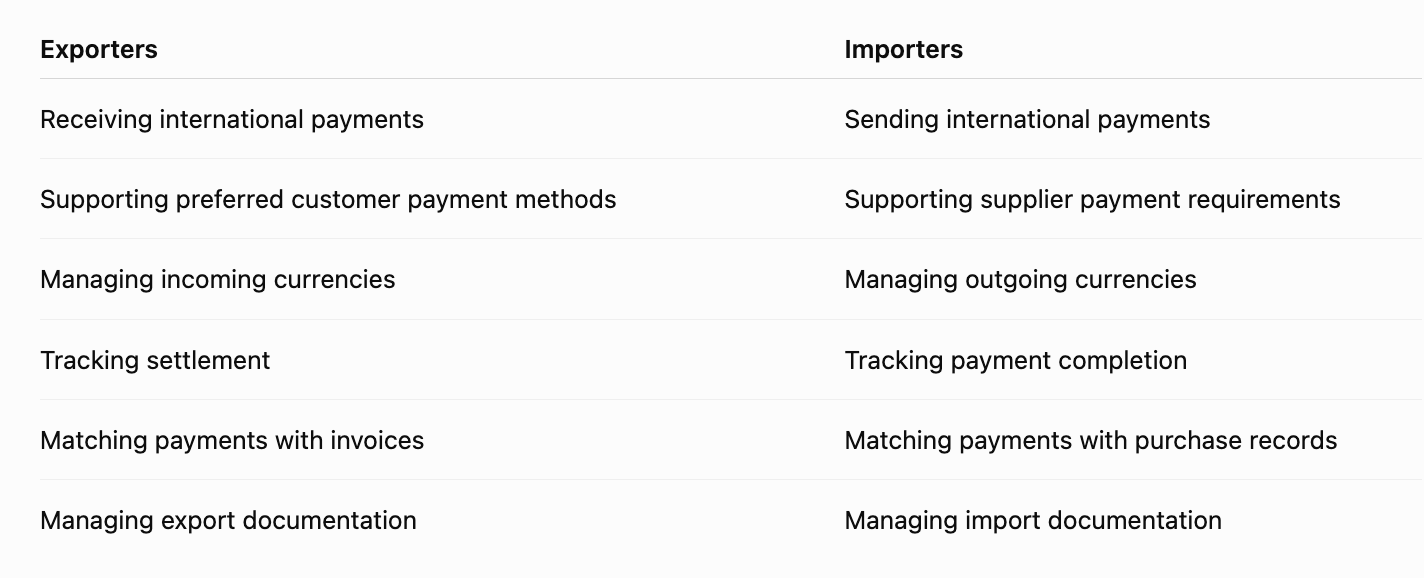
Exporters vs Importers: What Matters Most?
Although their payment flows are different, both need visibility, reliability, cost control, and efficient reconciliation.
Final Thoughts
For exporters and importers, cross-border payments are an important part of doing business internationally. The right payment setup can help reduce payment friction, improve visibility, and make reconciliation easier.
Expanding into global markets? Toucan Payments helps businesses manage payment processing, routing, settlement, and reconciliation through a connected payment infrastructure.
Frequently Asked Questions
Q1: What are cross border payments for exporters?
A: Cross border payments allow exporters to receive payments from customers located in other countries through banks or payment providers.
Q2: How do importers make international payments?
A: Importers can use banks, payment providers, or other supported payment channels to send funds to overseas suppliers.
Q3: What are the main challenges with cross border payments?
A: Common challenges include payment delays, transaction costs, currency conversion, payment failures, compliance, and manual reconciliation.
Q4: How can exporters reduce international payment costs?
A: Exporters can compare payment providers, currency conversion rates, transaction fees, and settlement options to find a more efficient payment setup.
Q5: How can businesses simplify cross border payment reconciliation?
A: Using connected payment infrastructure with centralised transaction visibility and automated reconciliation can reduce manual finance work and make payment tracking easier.