Domestic vs Cross-Border Payment Gateways: Which One Does Your Business Need?
Introduction
Choosing a payment gateway depends on more than just transaction fees. Where your customers are located, which currencies they use, the payment methods they prefer, and where you need to settle funds all matter.
So, which one is right for your business?
Let’s compare domestic and cross-border payment gateways and look at what you should consider before making a decision.
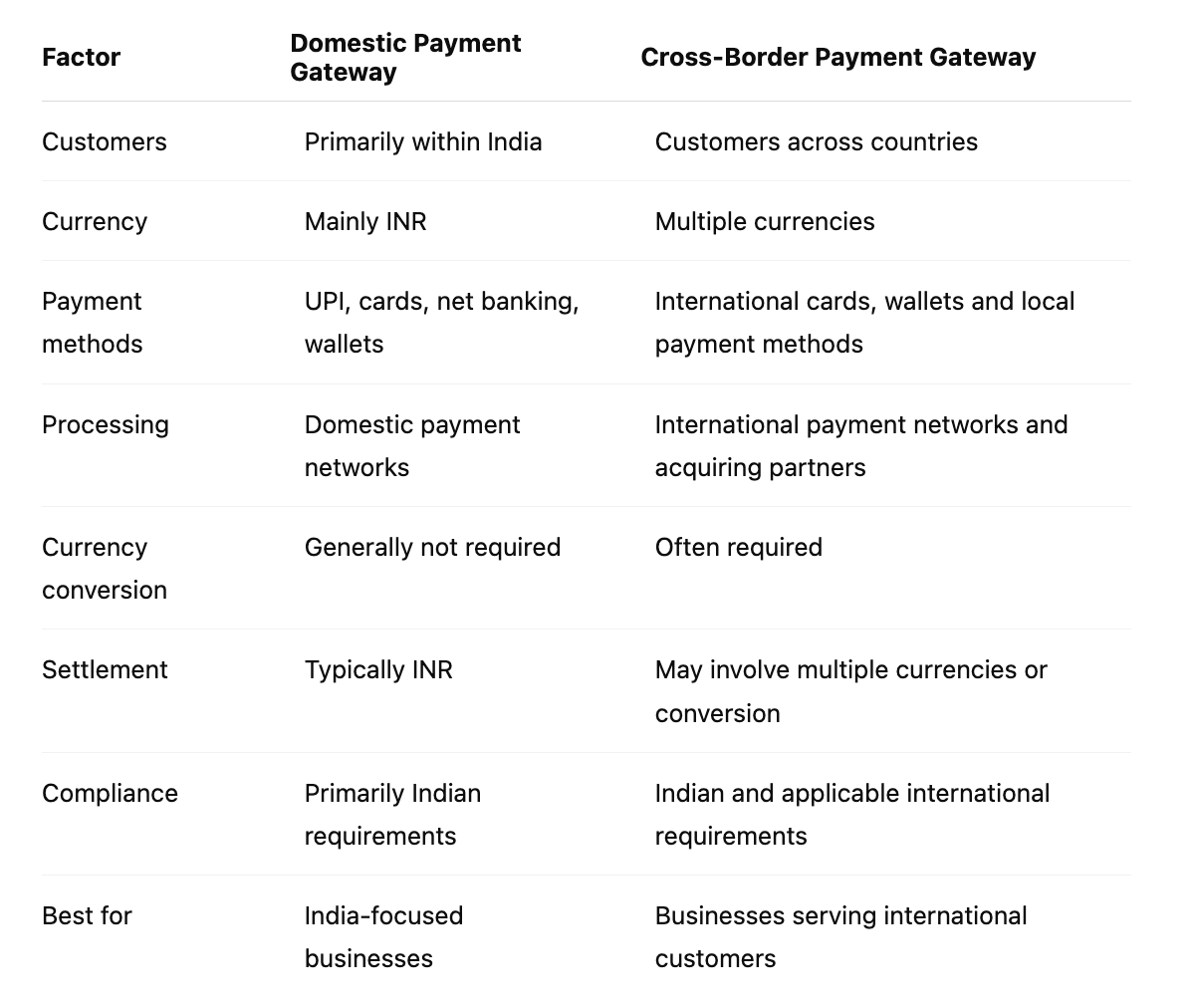
Domestic vs Cross-Border Payment Gateways: At a Glance
Compare key differences in coverage, currencies, settlement, fees, and payment methods.
What Is a Domestic Payment Gateway?
A domestic payment gateway allows businesses to accept online payments from customers within India. Customers can typically pay using methods such as:
1. UPI
2. Credit and debit cards
3. Net banking
4. Digital wallets
5. Other supported local payment methods
For example, an Indian ecommerce brand selling exclusively to customers in India may only need INR payments and Indian payment methods. In this case, a domestic payment gateway can provide the functionality the business needs without adding unnecessary complexity.
When Should You Choose a Domestic Gateway?
A domestic payment gateway may be the right choice if:
1. Your customers are primarily in India.
2. You accept payments in INR.
3. You mainly rely on UPI and Indian payment methods.
4. Your business does not currently accept international payments.
5. You have no immediate plans to expand internationally.
What Is a Cross-Border Payment Gateway?
A cross-border payment gateway enables businesses to accept payments from customers in other countries. Consider an Indian SaaS company selling subscriptions to customers in the US, UK and UAE. Those customers may expect to pay using international cards and in currencies such as USD, GBP or AED.
A cross-border payment setup can help businesses support international transactions while managing areas such as:
◆ Multiple currencies
◆ International payment methods
◆ Currency conversion
◆ International payment processing
◆ Settlement
◆ Refunds and chargebacks
◆ Reconciliation
◆ Applicable compliance requirements
If you want a broader understanding of the subject, explore our Cross-Border Payment Solutions for Indian Businesses guide.
Domestic vs Cross-Border Payment Gateways: Key Differences
Understand the key differences in fees, currencies, payment methods, compliance, and settlement.
1. Customer Location
The simplest question to ask is: Where are your customers?
If you sell only to customers in India, domestic payment capabilities may be sufficient. If you regularly accept payments from customers in other countries, you’ll need to evaluate cross-border capabilities.
For businesses serving both markets, having infrastructure that can support domestic and international payments can make expansion easier.
2. Currency Support
Domestic payments typically use INR.
International customers, however, may expect to see prices and make payments in their local currency. A customer in the US may prefer USD, while a customer in the UAE may expect AED.
When evaluating a cross-border provider, don’t just check which currencies customers can pay in. Also understand how currency conversion and settlement work, including the associated costs.
3. Payment Methods
Payment preferences vary by market.
Indian customers commonly use UPI, cards and net banking, while customers in other countries may prefer international cards, digital wallets or country-specific payment methods.
If you’re expanding internationally, payment method coverage should therefore be evaluated market by market.
4. Fees and Currency Conversion
Cross-border payments can involve additional costs compared with domestic transactions.
These may include:
◆ International processing fees
◆ Currency conversion charges
◆ Foreign exchange costs
◆ Acquiring fees
◆ Refund and chargeback costs
Don’t compare providers only on their advertised transaction fee. Look at the total cost of accepting, processing and settling a payment.
5. Settlement and Reconciliation
Settlement becomes especially important when you’re dealing with international transactions. Before choosing a provider, understand:
1. Which currencies can be settled?
2. How quickly are funds settled?
3. Where are funds settled?
4. What currency conversion charges apply?
5. How are refunds reflected?
6. How easily can your finance team reconcile transactions?
A payment gateway should not only help you collect money—it should also make it easier to understand where that money went.
Which Payment Gateway Does Your Business Need?
Choose the right payment gateway based on your business needs, payment methods, and customer journey. Choose Domestic If You:
1. Sell only in India
Your customers and transactions are primarily domestic.
2. Accept INR payments
You don’t need regular multi-currency acceptance.
3. Rely on Indian payment methods
UPI, cards and net banking cover your primary customer needs.
4. Have no immediate international expansion plans
Your payment requirements are currently India-focused.
Choose Cross-Border If You:
1. Have international customers
You regularly receive payments from customers outside India.
2. Sell internationally
This could include ecommerce, SaaS, digital services, education or other online businesses.
3. Need multiple currencies
Your customers expect to transact in currencies other than INR.
4. Plan to expand internationally
Your payment infrastructure needs to support new markets as you grow.
What If You Serve Both Indian and International Customers?
You don’t necessarily have to choose one or the other. Many growing businesses serve customers in India as well as overseas markets. Their payment infrastructure needs to support both domestic and international transactions. For example:
Indian customer → UPI/card → INR → domestic processing
International customer → International card → Foreign currency → Cross-border processing
The right setup can give businesses a consistent payment experience while helping their finance and operations teams manage transactions, settlements and reconciliation more efficiently.
Final Thoughts
The right payment gateway depends on where your customers are and where your business is heading.
For India-only businesses, a domestic gateway may be enough. If you serve international customers, consider currencies, payment methods, fees, settlement and compliance. Businesses serving both markets should choose a solution that supports domestic and cross-border payments as they grow.
Ready to simplify payments across markets? Explore a payment gateway built to support your business as it grows.
Frequently Asked Questions
Q1: What is the difference between domestic and cross-border payment gateways?
A: A domestic payment gateway primarily processes payments within India, while a cross-border payment gateway supports transactions involving international customers, currencies and payment networks.
Q2: Do Indian businesses need a cross-border payment gateway?
A: Only if they accept or plan to accept payments from customers outside India. Businesses operating exclusively in India may only need domestic payment capabilities.
Q3: Are cross-border payments more expensive?
A: They can involve additional costs such as currency conversion and international processing. Businesses should compare the total cost rather than only the basic transaction fee.
Q4: Can a business accept both domestic and international payments?
A: Yes. Businesses serving customers in India and overseas can use payment infrastructure that supports both domestic and cross-border transactions, depending on their requirements.
Q5: What should I check before choosing a cross-border payment gateway?
A: Compare countries and currencies supported, payment methods, transaction success rates, fees, currency conversion, fraud controls, settlement, reconciliation, integrations and scalability.