Digital Payments in Healthcare: Improving Patient Billing & Collections
Introduction
Healthcare is becoming increasingly digital, from booking appointments to accessing medical records. Payments are part of this shift too.
Patients today expect convenient ways to pay for consultations, diagnostics, hospital services, pharmacy purchases and other healthcare expenses. For hospitals, clinics and healthcare platforms, digital payments can make this process easier while helping finance teams manage billing and collections more efficiently.
But accepting digital payments is only one part of the process. The real value comes from connecting payments with billing, collections, refunds and reconciliation.
What Are Digital Payments in Healthcare?
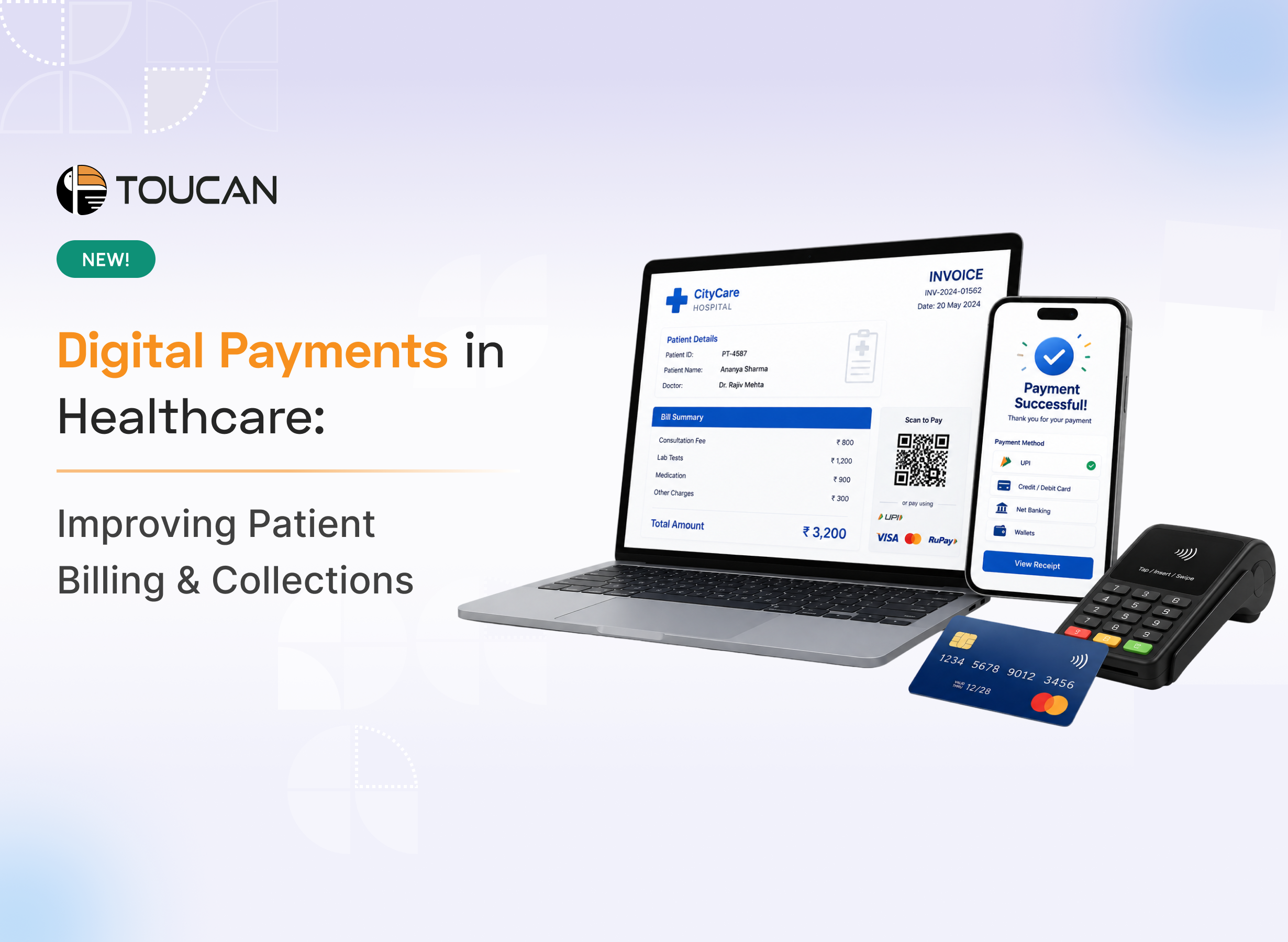
Digital payments in healthcare allow patients to pay for medical services electronically through channels such as UPI, cards, net banking, wallets, payment links and other digital methods.
These payments can be collected at different stages of the patient journey, including:
◆ Appointment booking
◆ Consultation fees
◆ Diagnostic services
◆ Hospital admission deposits
◆ Treatment and procedure payments
◆ Pharmacy purchases
◆ Outstanding bills
◆ Follow-up consultations
For healthcare providers, this creates a more convenient payment experience while reducing dependence on manual collection and cash handling.
Why Billing and Collections Can Be Challenging
Healthcare billing is often more complex than a single transaction.
A patient’s journey may involve multiple departments, services and payments. There may also be advance payments, partial payments, adjustments, refunds or changes to the final bill.
When payment information is spread across different systems, finance teams may have to spend considerable time checking transaction statuses, matching payments with invoices and following up on outstanding amounts.
This is where a well-connected digital payment setup can help.
How Digital Payments Improve Healthcare Billing
1. Make payments easier for patients
Patients do not always want to wait at a billing counter to complete a payment.
Digital payment options through websites, apps, patient portals or payment links allow patients to pay remotely and at a time that works for them.
A smoother payment experience can be particularly useful for appointment fees, advance payments and follow-up services.
2. Reduce manual collection work
Manual payment collection often requires teams to verify transactions, issue receipts and follow up on pending payments.
Digital payments can automate parts of this process and connect payment information with the healthcare provider’s existing billing or management systems.
This helps reduce repetitive administrative work and allows teams to focus on exceptions that actually need attention.
3. Improve transaction visibility
Healthcare businesses can process a high volume of transactions across multiple locations and services.
A centralised payment setup can give finance and operations teams better visibility into successful, failed, pending and refunded transactions.
Instead of checking different systems individually, teams can have a clearer view of the payment lifecycle.
4. Simplify reconciliation
Reconciliation is an important part of healthcare finance operations.
Teams need to match payments with invoices, billing records and settlements. When this information is fragmented, identifying mismatches can take time.
Digital payment infrastructure can bring transaction information into a more structured workflow, making it easier to track payments and settlements and identify exceptions.
Supporting Collections Beyond the Billing Counter
Digital payments can also help healthcare providers manage collections before and after a patient’s visit.
For example, a hospital or clinic can share a payment link for an outstanding invoice instead of requiring the patient to return to the facility.
Similarly, online payments can be used for advance deposits, follow-up consultations, diagnostic services or recurring healthcare services.
This gives patients more flexibility while providing healthcare businesses with additional ways to collect payments.
1. Managing Failed Payments
A failed payment does not always mean a patient is unwilling to pay. Transactions can fail because of bank issues, authentication problems, connectivity issues or other technical reasons.
For healthcare providers, having visibility into failed and pending transactions is therefore important.
A good payment setup should make it easy for teams to identify unsuccessful transactions and, where appropriate, provide patients with another opportunity or payment method to complete the payment.
For larger healthcare businesses, capabilities such as transaction monitoring and intelligent payment routing can become increasingly important as payment volumes grow.
2. Refunds Are Part of the Payment Journey
Healthcare payments can sometimes require refunds or adjustments.
A service may be cancelled, a patient’s final bill may change, or an excess payment may need to be returned. These situations make refund management an important part of the overall payment process.
Healthcare providers need clear visibility into refunds and adjustments so that payment records remain aligned with their billing systems.
The payment process should therefore be designed around the complete transaction lifecycle, rather than just successful payment acceptance.
3. Connecting Payments With Healthcare Systems
Payments work best when they are connected with the systems healthcare businesses already use. Depending on the organisation, this could include:
◆ Hospital Management Systems (HMS)
◆ Hospital Information Systems (HIS)
◆ Patient portals
◆ Appointment platforms
◆ ERP and accounting systems
◆ CRM platforms
Integration can reduce manual verification and help payment status flow into the relevant business workflow.
For example, a successful payment can automatically update the corresponding transaction or billing record, reducing the need for teams to manually confirm every payment.
What Should Healthcare Businesses Look for in a Payment Solution?
The right payment solution depends on the size, business model and payment requirements of the healthcare provider.
A small clinic may primarily need reliable online payment acceptance, while a multi-location hospital or healthcare platform may need deeper integrations, better transaction visibility, reconciliation support and more advanced payment capabilities. Key factors to consider include:
◆ Payment methods supported
◆ Integration capabilities
◆ Payment success and failure handling
◆ Transaction visibility
◆ Refund management
◆ Reconciliation and settlement reporting
◆ Security and compliance
◆ Scalability across locations and services
For a more detailed evaluation, read our guide on Choosing the Right Payment Gateway for Hospitals, Clinics & Healthcare Platforms.
Building a Better Healthcare Payment Experience
Digital payments are not simply about moving from cash to online transactions. They can help healthcare providers create a more connected billing and collections process.
For patients, this means easier ways to pay. For healthcare teams, it can mean better visibility, fewer manual processes and simpler reconciliation.
As hospitals, clinics and healthcare platforms continue to digitise their operations, payment infrastructure will play an increasingly important role in connecting the patient payment experience with billing and financial operations.
The focus should not only be on accepting payments, but on building a payment journey that works smoothly from billing and collection to settlement, reconciliation and refunds.
Final Thoughts
Digital payments can simplify healthcare billing, collections and reconciliation while creating a smoother payment experience for patients. For hospitals, clinics and healthcare platforms, the right payment infrastructure can improve payment management today and support future growth.
Looking for the right payment solution for your healthcare business? Explore Toucan Payments.
Frequently Asked Questions
Q1. What are digital payments in healthcare?
A: Digital payments allow patients to pay for healthcare services through UPI, cards, net banking, wallets and payment links.
Q2. How do digital payments improve healthcare billing?
A: They make payments easier for patients and help healthcare providers reduce manual billing and collection work.
Q3. How can hospitals improve payment collections?
A: Hospitals can offer convenient digital payment options for appointments, deposits, outstanding bills and other services.
Q4. Why is payment reconciliation important in healthcare?
A: It helps healthcare providers match payments with billing records and settlements, reducing manual errors and mismatches.
Q5. What should hospitals look for in a payment solution?
A: They should consider payment methods, integrations, transaction visibility, refunds, reconciliation, security and scalability.