FIRA vs FIRC: What’s the Difference for Cross-Border Payments?
Introduction
Receiving money from an international customer sounds simple. The payment reaches your Indian bank account, the invoice is closed, and the transaction is done. But for businesses handling cross-border payments, there is another important part to consider: documentation.
This is where FIRA vs FIRC becomes important. Both are connected to foreign inward remittances, but they serve different purposes and may be used in different situations.
Understanding the difference between FIRA and FIRC can help businesses manage international payments, accounting, reconciliation, and compliance more effectively.
What Is FIRA?
FIRA stands for Foreign Inward Remittance Advice. It is a document or electronic advice that provides details about money received in India from an overseas source. A FIRA can contain information such as:
1. Name of the remitter
2. Name of the beneficiary
3. Amount received
4. Foreign currency
5. INR equivalent
6. Date of receipt
7. Exchange rate
8. Purpose of the payment
9. Transaction reference
For example, an Indian software company receives USD 5,000 from a customer in the US. The bank or payment provider may provide inward remittance details that help the company identify and record the payment. This information can be useful for accounting and payment reconciliation.
What Is FIRC?
FIRC stands for Foreign Inward Remittance Certificate. It is a formal certificate associated with the receipt of foreign currency through banking channels. It can be required for specific transactions or regulatory purposes.
A FIRC generally contains details that establish that a particular amount of foreign currency was received by the beneficiary.
However, businesses should not assume that every international payment requires a FIRC. The requirement depends on the nature of the transaction, the payment route, and what the bank or relevant authority requires.
This is also why businesses may come across terms such as e FIRC, FIRA, and inward remittance advice when dealing with international payments.
FIRA vs FIRC: What Is the Difference?
The simplest way to understand the difference is to look at what each document is intended to do.
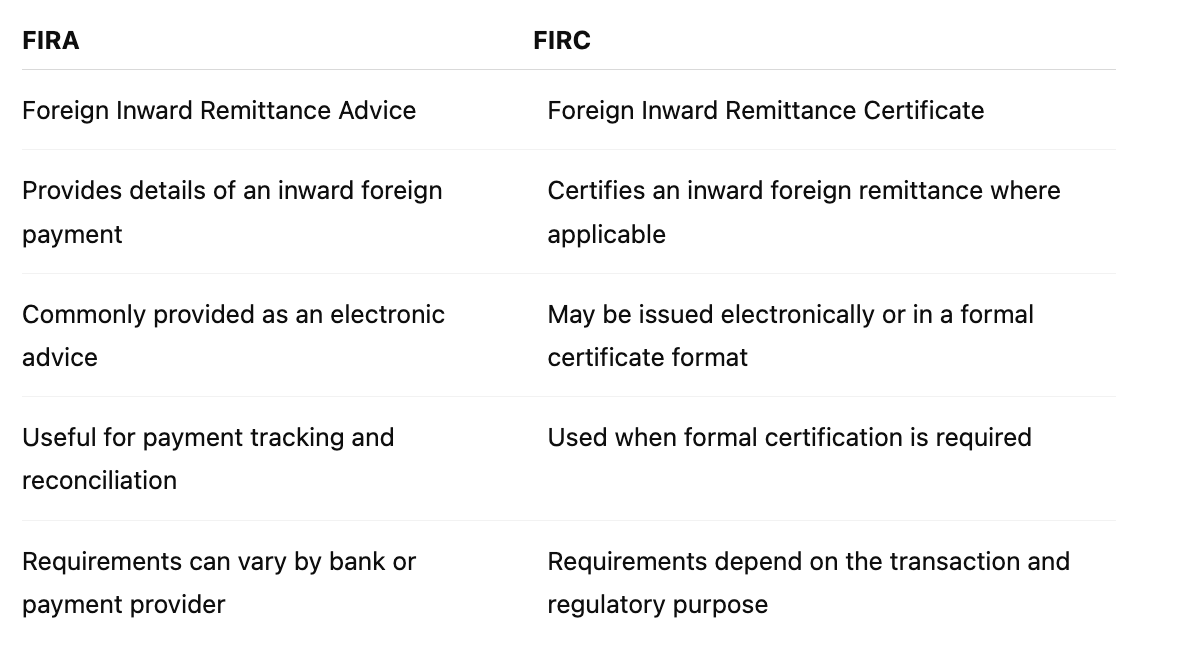
The two terms are closely related, but they should not automatically be treated as interchangeable. If a customer or authority specifically asks for a particular document, the business should confirm the requirement with its bank or payment provider.
FIRA vs FIRC: A Simple Example for Indian Businesses
Suppose an Indian consulting company receives USD 10,000 from a client in Singapore.
The payment is processed through the relevant banking or payment network and eventually reaches the company’s Indian account. The company now needs to record the payment against the client’s invoice.
The inward remittance documentation can help the finance team verify:
1. Who sent the money
2. How much was received
3. When it was received
4. The currency involved
5. The INR value
6. The purpose of the transaction
7. The relevant transaction reference
Depending on the transaction and payment route, the company may receive FIRA, FIRC, e FIRC, or another form of inward remittance documentation.
The key point is that the required document depends on the transaction rather than simply the fact that the payment came from overseas.
When Is FIRA Useful?
FIRA can be useful for businesses that regularly receive payments from international customers.
1. Export of services: IT companies, SaaS businesses, consultants, agencies, and other service providers often receive payments from overseas clients. Remittance information helps connect the incoming payment with the relevant invoice.
2. Payment reconciliation: Finance teams can use remittance details to match payments with invoices and bank records. This becomes increasingly important when a company receives multiple international payments every month.
3. Accounting records: Maintaining clear records of foreign inward payments can make it easier for finance teams to track international revenue and maintain supporting documentation.
When Is FIRC Required?
FIRC becomes relevant when a formal certificate is required for a particular transaction or regulatory purpose. This can apply to certain foreign exchange transactions, investments, or other situations where evidence of the inward remittance is specifically required.
For businesses receiving international payments for regular services or exports, it is important to first understand what documentation is actually required rather than automatically requesting a FIRC.
The bank, payment provider, accountant, or relevant authority can confirm the applicable requirement.
FIRA vs FIRC vs e-BRC
Businesses involved in international trade may also come across e-BRC, which is another important document.
An e BRC is related to the realisation of export proceeds and connects the payment received with the underlying export transaction.
These documents therefore have different roles:
FIRA: Provides information about an inward foreign remittance.
FIRC: Provides formal certification of an inward foreign remittance where applicable.
e-BRC: Connects export realisation with the underlying export transaction.
Knowing the difference can help businesses avoid using the wrong document for a particular requirement.
Why Does This Matter for Cross-Border Payments?
As businesses expand internationally, managing payments involves more than simply accepting money. A typical payment can move through several stages before reaching the business:
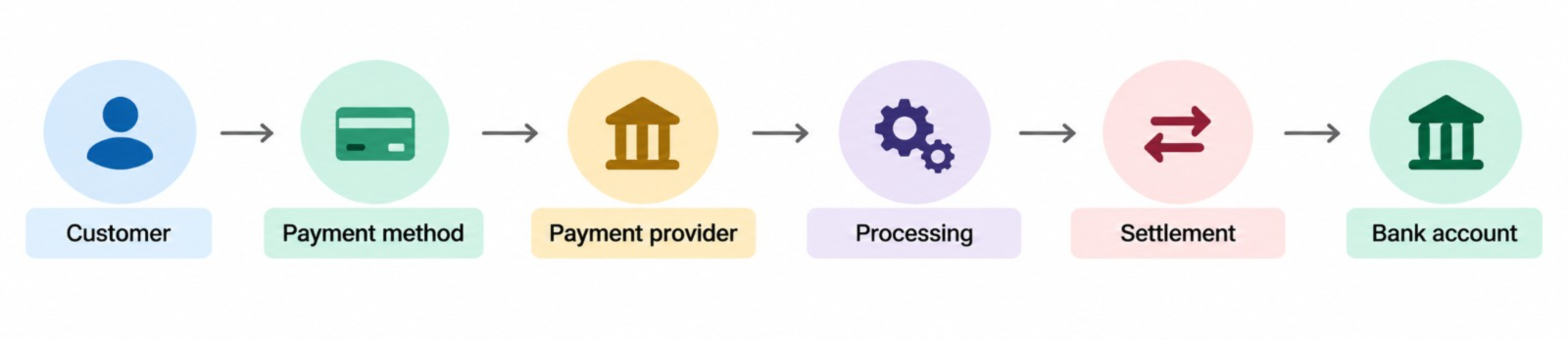
Businesses need visibility across this entire flow. When payment volumes increase, manually matching bank transactions, invoices, settlement reports, and remittance information can become difficult.
This is where a well connected payment infrastructure can make a difference.
Businesses can benefit from:
1. Centralised payment visibility
2. Multiple payment connections
3. Settlement tracking
4. Automated reconciliation
5. Transaction level reporting
6. Better payment monitoring
7. Support for multiple currencies
For companies working with several payment providers, payment orchestration can also bring different payment connections into a more organised workflow.
Learn how Indian businesses can simplify international payments with Cross-Border Payment Solutions for Indian Businesses. Read More
Which One Does Your Business Need?
There is no single answer for every business. The right documentation depends on the type of payment, its purpose, the payment route, and the requirements of the receiving bank or relevant authority.
Before requesting FIRA or FIRC, businesses should check:
1. What type of transaction was made?
2. What was the purpose of the payment?
3. Which bank or payment provider processed it?
4. Is the payment related to an export, investment, or another transaction?
5. What documentation is required for accounting or compliance?
Final Thoughts
FIRA and FIRC are both related to foreign inward remittances, but they are not exactly the same.
FIRA generally provides details of an inward foreign payment, while FIRC serves as formal certification where required. For businesses receiving international payments, knowing which document applies can make accounting, reconciliation, and compliance easier.
Managing cross-border payments at scale? Explore how Toucan Payments can help simplify payment processing, settlement, and reconciliation.
Frequently Asked Questions
Q1: What is the difference between FIRA and FIRC?
A: FIRA provides details of an inward foreign remittance, while FIRC is a formal certificate issued where required for specific transactions.
Q2: Is FIRA the same as FIRC?
A: No. They are related but are not always interchangeable. The required document depends on the transaction and its purpose.
Q3: Who issues FIRA and FIRC?
A: These documents are generally provided by the relevant bank or eligible payment provider, depending on the transaction and payment route.
Q4: Is FIRC required for every foreign payment?
A: No. A FIRC is not automatically required for every international payment. The requirement depends on the nature and purpose of the transaction.
Q5: What is the difference between FIRA, FIRC and e BRC?
A: FIRA provides inward remittance details, FIRC provides formal certification where applicable, and e BRC is linked to the realisation of export proceeds.