Remittance Market Disruption: How Fintechs Challenge Traditional Money Transfer
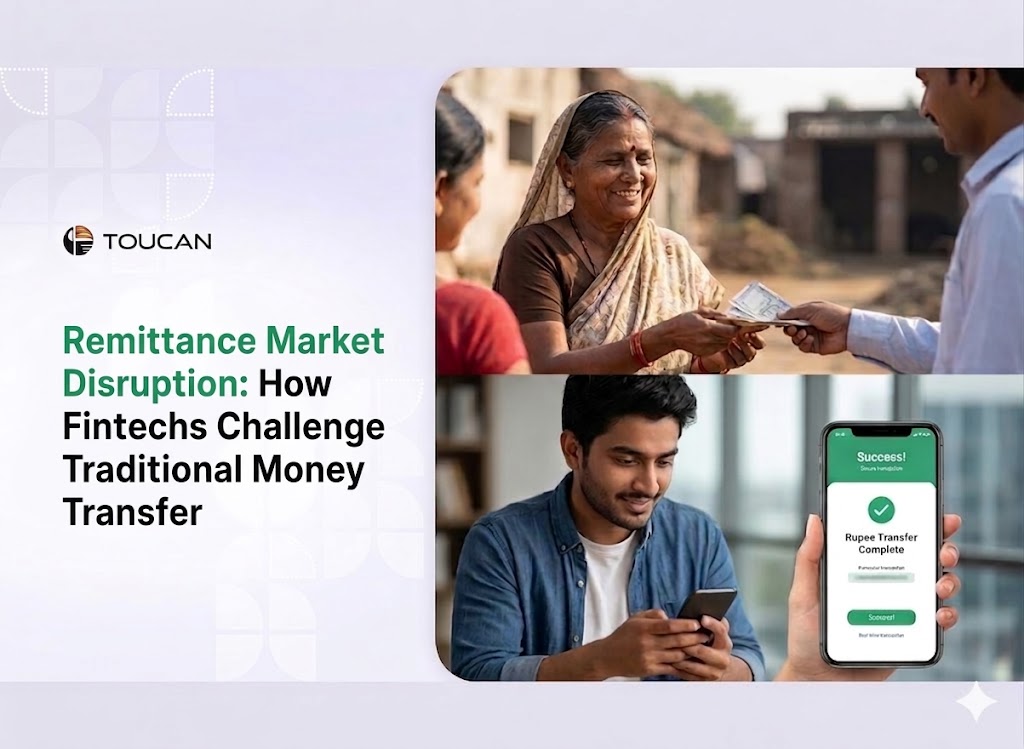
Every year, hundreds of millions of migrant workers send money home to support their families. In 2024, global remittances were estimated at a staggering $905 billion, with roughly $685 billion flowing to low- and middle-income countries.
For decades, global remittance corridors were dominated by established players, money transfer operators (MTOs), banks, and exchange houses. Yet, a new wave of digital-first fintech companies is transforming how migrants send money home. The global remittance market is now at an inflection point, moving away from cash-heavy, expensive systems to frictionless, real-time digital transfers.
The Legacy Remittance Landscape
Traditional remittance systems relied on agent networks and manual processes. While dependable and regulated, they came with several pain points:
1. High transaction fees: Average costs often exceeded 6–7% per transaction. (Source: World Bank Remittance report)
2. Long settlement cycles: Transfers could take days to reach beneficiaries.
3. Limited transparency: Exchange rates and service fees were often non-transparent.
4. Geographical constraints: Rural or remote recipients had to travel to physical outlets.
How Fintechs Are Disrupting the Remittance Market
Fintech remittance providers are not simply digitising the same old process. They are rethinking the architecture of cross-border payments from the ground up. Here’s how they’re doing it.
1️⃣ Real-time payments: Leveraging systems like UPI, InstaPay, or Faster Payments, users now enjoy near-instant transfers.
2️⃣ Transparent foreign exchange (FX) rates: Digital platforms display live rates upfront, reducing hidden costs.
3️⃣ Lower fees through direct routing: Many fintechs bypass intermediary banks via payment corridors, cutting transaction costs by up to 60%.
4️⃣ Mobile-first accessibility: Increasing smartphone penetration allows customers to manage remittances anytime, anywhere.
5️⃣ Reg–tech integration: Automated KYC, AML, and transaction monitoring ensure compliance without friction.
The Regulatory Balancing Act
Regulators play a vital role in ensuring this innovation remains secure. From RBI in India to FCA in the UK and FinCEN in the U.S., oversight frameworks are evolving to accommodate API-based money transfer models. Fintechs must maintain robust compliance structures, including real-time fraud monitoring, data encryption, and licensing under local remittance laws.
What’s Next: The Future of Global Remittances
Several developments are likely to shape the next phase of the remittance market’s evolution:
- Real-time cross-border payment rails are being rolled out in multiple regions. India’s UPI, Brazil’s PIX, and similar infrastructure in Australia, the EU, and parts of Africa are creating the plumbing for instant, low-cost international settlement.
- AI-powered compliance and fraud detection is maturing rapidly. The intersection of artificial intelligence and financial services is projected to grow from $30 billion in 2025 to over $83 billion by 2030, and remittance providers are among the earliest and most enthusiastic adopters.
- Central Bank Digital Currencies (CBDCs) could fundamentally reshape cross-border settlement if they gain traction. While still largely in pilot stages, CBDCs represent a potential new layer of public infrastructure for international payments.
- Embedded finance — the integration of remittance functionality into non-financial apps, messaging platforms, and e-commerce ecosystems, is expanding the points of access for senders.
Conclusion
Fintechs have not merely disrupted the remittance market; they’re redefining how money moves across borders. As the global economy becomes more interconnected, the demand for low-cost, transparent, and instant cross-border payments will continue to soar. Those leveraging next-generation payment infrastructure and strong compliance foundations will shape the remittance landscape of tomorrow.
Ready to go borderless? Connect with Toucan Pay Now
Frequently Asked Questions
Q1: What are remittances and why are they important?
A: Remittances are money sent by individuals, usually migrants working abroad, back to their home countries. They are a critical source of income for households in many low‑ and middle‑income countries and play a large role in national savings, consumption, and financial inclusion.
Q2: How are fintechs changing traditional money transfer services?
A: Fintechs are replacing slow, opaque, and expensive legacy systems with digital platforms. They also leverage APIs, cloud infrastructure, and embedded finance to integrate remittances into broader financial ecosystems.
Q3: Are fintech remittances safe and regulated?
A: Most reputable fintech remittance providers operate under local financial regulations and hold required licenses. They also implement KYC, AML checks, data encryption, and transaction‑monitoring tools. However, users should always verify a provider’s regulatory status and security practices before sending money.