FX volatility in cross-border payments: how businesses can manage risk
In FY2024, the INR depreciated roughly 8.3% against the USD. For an Indian exporter with a ₹1 crore USD receivable sitting unhedged for 90 days, that single movement represented an ₹8.3 lakh swing in realized revenue — on a deal where margins may have been 12–15%.
FX volatility doesn’t announce itself. It moves while your invoice is outstanding, while your payment is in transit, while your bank processes a wire. By the time money hits your account, the rate you quoted is no longer the rate you’re getting paid at.
What Causes FX Volatility?
Foreign exchange volatility refers to the constant fluctuation in the exchange rate between two currencies. Several macroeconomic factors drive these continuous swings:
➤ Interest Rates & Inflation: Central bank decisions and inflation levels heavily influence a currency’s attractiveness to global investors.
➤ Geopolitical Events: Elections, trade wars, and global conflicts can cause sudden spikes or drops in currency value.
➤ Market Sentiment: Speculative trading and global economic outlooks can create short-term currency turbulence.
For businesses making B2B international payments, this volatility means that a $10,000 invoice could cost your business significantly more in Indian Rupees (INR) today than it did just a week ago.
The Hidden Costs of Currency Fluctuations
If your business regularly sends or receives international payments without a risk management strategy, you are exposing yourself to several critical issues:
1. Eroded Profit Margins
If the INR weakens against the USD before you pay an overseas supplier, your cost of goods suddenly increases, eating directly into your profits.
A $50,000 invoice raised at ₹84.50 = ₹42.25 lakh. If INR strengthens to ₹82.00 by payment date, you receive ₹41.00 lakh — a ₹1.25 lakh shortfall on the same deal, wiping nearly 20% of profit on a 15% margin business.
2. Unpredictable Cash Flow
Budgeting and financial forecasting become incredibly difficult when the exact cost of your overseas operations or the value of your export revenues fluctuates daily.
3. Pricing Disadvantages
To buffer against currency swings, businesses often inflate their prices. This can make your products or services less competitive in the global market.
4. Settlement Timing Risk
Every day your payment spends in SWIFT transit is a day your funds are exposed to rate movement. A ₹50 lakh transfer delayed 3 business days during a volatile period can cost ₹75,000–₹1.5 lakh in additional conversion loss. T+0 settlement eliminates this window entirely.
How Businesses Can Manage FX Risk Effectively
Fortunately, you don’t have to leave your profits to the mercy of the market. Here are proven strategies to manage FX volatility in cross-border transactions:
1. Utilize Forward Contracts
A forward contract allows you to lock in a specific exchange rate for a future date. If you know you have a €50,000 payment due in three months, a forward contract protects you from the Euro appreciating against the Rupee during that time. It provides certainty, allowing for accurate cash flow forecasting.
2. Practice “Natural Hedging”
Natural hedging involves matching your foreign currency revenues with your foreign currency expenses. For example, if you earn in US Dollars from clients in the US, but also have server hosting or marketing expenses billed in USD, pay those expenses directly from your USD earnings. This minimizes the need to convert currencies back and forth, reducing your exposure to shifting rates.
3. Adjust Invoicing Strategies
Consider invoicing your clients in your home currency (INR) to shift the FX risk to the buyer. Alternatively, you can include an exchange rate clause in your contracts, stipulating that prices will be renegotiated if the currency fluctuates beyond a certain percentage threshold.
4.Leverage Multi-Currency Accounts
Opening a multi-currency account allows you to receive, hold, and send funds in various foreign currencies without being forced to convert them immediately into INR. You can choose to convert your funds when the exchange rate is favourable, giving you control over your cross-border payment timing.
5.Upgrade Your Payment Infrastructure
Traditional banks often hide hefty margins in their exchange rates and take days to process international transfers, leaving your funds exposed to prolonged market volatility. Partnering with a modern, specialized payment provider is one of the most effective ways to mitigate this risk.
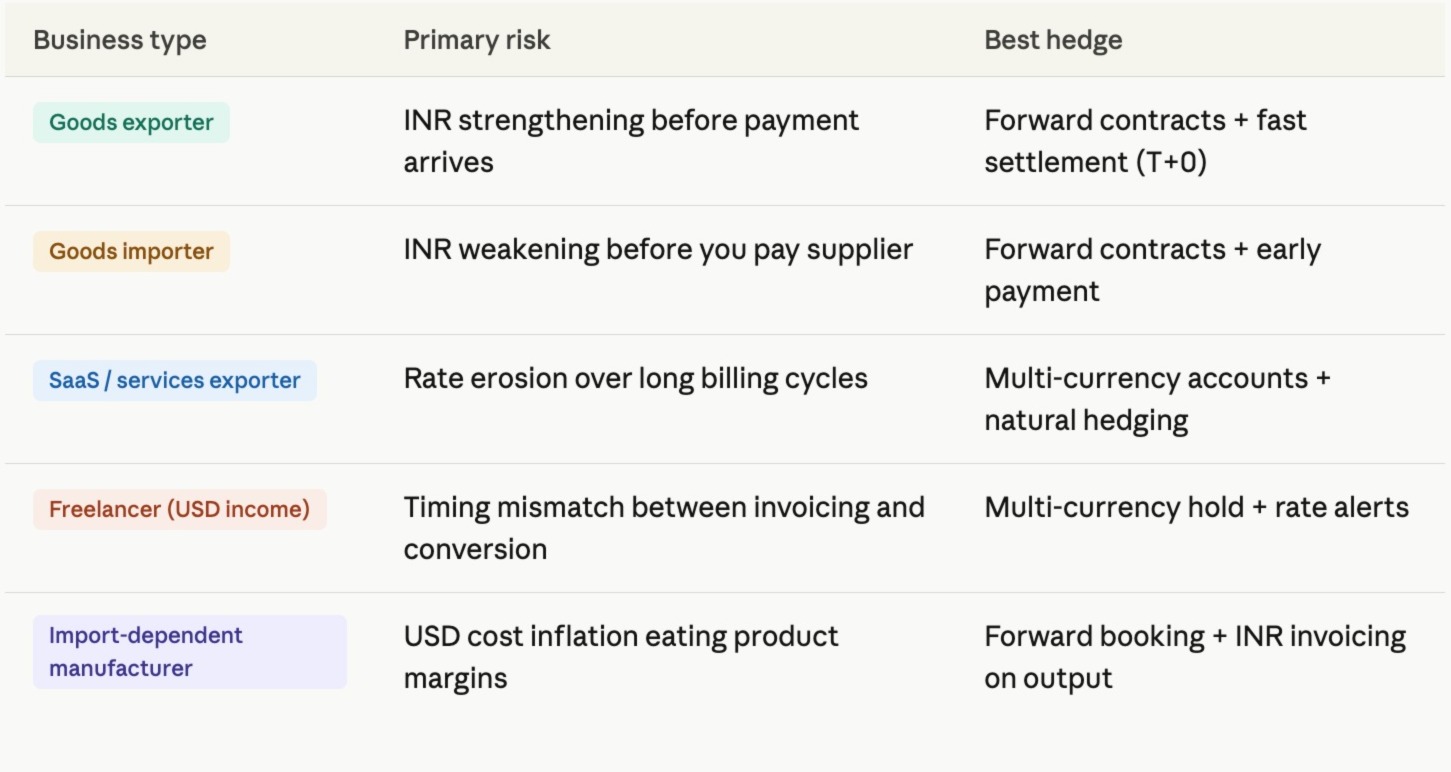
FX risk by business type
For Indian businesses with cross-border exposure
Conclusion
FX volatility is an unavoidable reality of international trade, but it doesn’t have to be a threat to your business. By understanding your exposure and utilizing tools like forward contracts, natural hedging, and modern payment platforms, you can turn unpredictability into a calculated, manageable variable.
Don’t let currency fluctuations dictate your profit margins. Take control of your international transactions today. Visit ToucanPay.in to discover how our cross-border payment solutions can help your business thrive on the global stage.
Frequently Asked Questions
Q1: What is FX volatility in cross-border payments?
A: FX volatility refers to the unpredictable and constant fluctuation in exchange rates between two currencies.
Q2: How can Indian SMEs manage foreign exchange risk effectively?
A: SMEs can mitigate currency risk by employing several strategies: using forward contracts to lock in exchange rates, practicing “natural hedging” by matching foreign income with foreign expenses, invoicing overseas clients in INR where possible, and using specialized multi-currency accounts to hold funds until rates are favourable.
Q3: Why are traditional banks sometimes inefficient for managing FX risk?
A: Traditional banking channels often suffer from slow settlement times, extending the window of exposure where currency rates can change. Additionally, they frequently apply hidden markups on currency conversion and charge high SWIFT transfer fees, which further diminishes profit margins on cross-border transactions.
Q4: Can I hold foreign currency to wait for a better exchange rate?
A: Yes. By utilizing multi-currency accounts, businesses can receive and hold payments in currencies like USD, EUR, or GBP.
Q5: How does Toucan help businesses handle cross-border payments?
A: Toucan provides distinct, modern payment offerings, designed specifically for international transactions. By providing highly competitive, real-time FX rates, faster settlement times, and complete transparency on pricing, Toucan helps Indian businesses minimize their exposure to currency fluctuations and maximize the value of their global trade.