2D vs 3D Payment Gateway in India: How Card Authentication Works
Introduction
2D vs 3D payment gateway is an important consideration for businesses accepting online card payments in India. Whether customers are paying for an ecommerce order, school fees, an insurance premium, or a subscription, the payment gateway plays an important role in moving the transaction from the customer to the merchant and the bank.
However, not every card payment follows the same authentication process. Understanding how 2D and 3D payment gateways work can help businesses evaluate security, compliance, customer experience, and payment success rates when choosing their payment infrastructure.
What Is a 2D Payment Gateway?
A 2D payment gateway allows a card transaction to be processed using basic card details without requiring an additional authentication step from the customer.
Typically, the customer enters details such as:
1. Card number
2. Expiry date
3. CVV
The payment gateway sends these details to the acquiring bank and card network for authorization. If the issuing bank approves the transaction, the payment is completed.
The process is relatively simple because there is no additional authentication screen or verification step.
For example, a customer shopping online may enter their card details and complete the payment without being redirected to an additional authentication page.
How Does 2D Card Payment Work?
The typical process looks like this:
1. The customer enters their card details on the merchant checkout page.
2. The payment gateway securely sends the transaction information for authorization.
3. The acquiring bank forwards the request through the relevant card network.
4. The issuing bank checks the transaction.
5. The transaction is approved or declined.
6. The customer receives the payment confirmation.
The fewer steps can create a smoother checkout experience. However, businesses need to consider the security and regulatory requirements applicable to their market and transaction type.
What Is a 3D Payment Gateway?
A 3D payment gateway adds an additional cardholder authentication step to the payment process.
The term 3D refers to the involvement of three domains in the authentication ecosystem: the merchant or acquirer domain, the issuer domain, and the interoperability domain represented by the card network.
During a 3D Secure transaction, the customer may be asked to complete an additional verification step. Depending on the authentication method, this could involve an OTP, banking application approval, biometric authentication, or another authentication method.
For Indian customers, this additional authentication is particularly familiar because online card transactions commonly involve an additional verification step before the payment is completed.
How Does 3D Secure Authentication Work?
A typical 3D Secure payment journey can look like this:
1. The customer selects card payment at checkout.
2. The customer enters their card details.
3. The payment gateway sends the authentication request.
4. The card issuer evaluates the transaction.
5. The customer completes the required authentication.
6. The issuer confirms the authentication.
7. The transaction is authorized.
8. The merchant receives the payment confirmation.
Modern 3D Secure implementations can also support risk based authentication. In some cases, the transaction may be considered low risk and the customer may not need to complete an additional challenge.
This can help businesses maintain security without unnecessarily adding friction to every transaction.
2D vs 3D Payment Gateway: Key Differences
The main difference between 2D and 3D payment processing is the authentication experience.
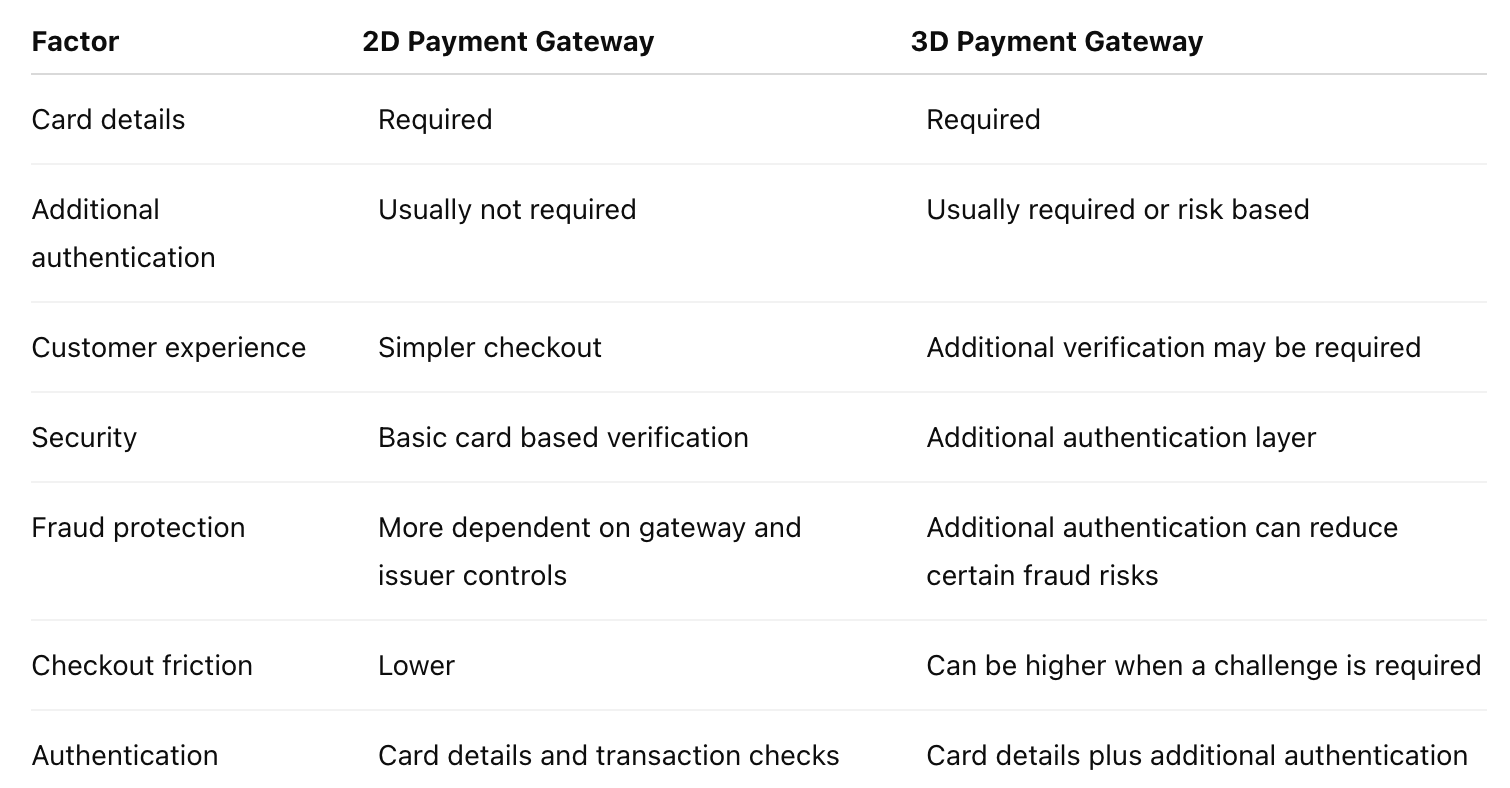
The actual payment experience can vary depending on the card network, issuing bank, merchant setup, transaction type, and authentication framework being used.
2D vs 3D Payment Gateway in India
For businesses operating in India, choosing between different payment authentication approaches is not simply a matter of selecting the option with fewer checkout steps.
Indian businesses need to consider applicable regulatory requirements, card network rules, issuer requirements, fraud prevention measures, and customer expectations.
The Reserve Bank of India has introduced additional security requirements for digital payments, including additional factor authentication for applicable transactions. Because of these requirements, businesses should work with payment partners that support compliant authentication flows rather than assuming that a traditional 2D or 3D model applies to every transaction.
This is particularly important for businesses processing high transaction volumes, recurring payments, international transactions, or payments across multiple customer segments.
Which Payment Gateway Should Businesses Choose?
There is no single payment authentication approach that works equally well for every business. A business should evaluate its payment gateway based on several factors:
1. Security: Look for strong authentication, fraud monitoring, encryption, tokenization, and other security controls.
2. Payment Success Rate: Authentication should improve security without unnecessarily causing payment failures. A payment gateway with intelligent transaction routing and strong issuer connectivity can help improve the overall payment experience.
3. Customer Experience: Customers expect fast and simple checkout experiences. Additional authentication should be introduced where required without creating unnecessary friction.
4. Regulatory Compliance: Indian businesses should ensure that their payment infrastructure follows applicable RBI requirements and card network rules.
5. Payment Method Coverage: Businesses may need to support cards along with UPI, net banking, wallets, bank transfers, and other payment methods. A gateway that provides multiple payment options through one integration can simplify payment management.
6. Reporting and Reconciliation: Payment processing does not end when the customer sees a successful payment message. Businesses also need accurate transaction reporting, settlement tracking, refunds, and reconciliation.
How Payment Orchestration Can Help
For businesses operating across multiple payment providers, managing different authentication and payment flows can become complex.
Payment orchestration provides a layer that can connect merchants with multiple payment processors and payment methods through a unified integration.
It can help businesses manage payment routing, transaction monitoring, fraud controls, payment retries, and reporting from a central layer.
For businesses expanding across markets, this approach can also make it easier to manage different payment requirements and providers without creating multiple independent integrations.
2D vs 3D Payment Gateway: What Should You Remember?
The biggest difference between 2D and 3D payment processing is the level and method of cardholder authentication.
A 2D payment flow generally focuses on card details and authorization without an additional authentication challenge. A 3D Secure flow introduces an additional authentication layer that can provide stronger protection against certain types of unauthorized transactions.
For businesses in India, the right approach depends on the transaction, applicable regulations, customer experience requirements, payment methods, and the capabilities of the payment gateway.
Instead of looking only at whether a gateway is 2D or 3D, businesses should evaluate the complete payment infrastructure, including security, authorization rates, fraud prevention, routing, compliance, reporting, and customer experience.
Final Thoughts
The difference between 2D and 3D payment gateways goes beyond the number of steps a customer sees at checkout. It is ultimately about how cardholder authentication, security, compliance, and payment experience work together.
For Indian businesses, the right payment infrastructure should provide secure authentication while keeping the payment journey simple and reliable. A flexible payment gateway or orchestration platform can help businesses manage these requirements as their transaction volumes and payment needs grow.
Looking for a payment infrastructure that can support secure, reliable, and scalable transactions? Explore our Payment Gateway solutions to see how your business can build a better payment experience.
Frequently Asked Questions
Q1: What is the difference between 2D and 3D payment gateways?
A: A 2D payment gateway generally processes card payments using card details without an additional authentication challenge. A 3D Secure payment flow adds a cardholder authentication layer before authorization.
Q2: Is 3D Secure safer than 2D payment processing?
A: 3D Secure can provide an additional layer of cardholder authentication and can help reduce certain types of card fraud. However, overall payment security also depends on the gateway, issuer, card network, fraud controls, and transaction environment.
Q3: Is 3D Secure mandatory for card payments in India?
A: Authentication requirements depend on the transaction and applicable regulatory and card network rules. Businesses should use payment providers that support the authentication requirements applicable to their transactions.
Q4: Does 3D Secure reduce payment success rates?
A: An additional authentication step can sometimes create friction or abandonment. Modern authentication systems use risk based approaches to reduce unnecessary challenges while maintaining security.
Q5: How should businesses choose a payment gateway in India?
A: Businesses should evaluate security, regulatory compliance, payment success rates, payment method coverage, fraud prevention, routing capabilities, reporting, reconciliation, and the overall checkout experience.