Choosing the Right Payment Gateway for Hospitals, Clinics & Healthcare Platforms
Introduction
Healthcare payments are different from typical ecommerce transactions. A patient may pay for a consultation today, settle a hospital bill later, pay for a diagnostic test, purchase medicines, or make recurring payments for a healthcare plan.
Hospitals and healthcare platforms therefore need a payment gateway that can support different payment journeys while keeping transactions secure and easy to manage.
A reliable payment gateway can help hospitals, clinics, diagnostic centres, pharmacies, and digital healthcare platforms simplify collections and give patients a smoother payment experience.
But how do you choose the right payment gateway for healthcare?
This guide explains what a healthcare payment gateway is, how it works, the key features to consider, and what healthcare businesses should check before integrating one.
What Is a Payment Gateway in Healthcare?
A healthcare payment gateway is a technology that allows hospitals, clinics, diagnostic centres, pharmacies, and healthcare platforms to securely accept digital payments from patients and customers.
It connects the healthcare business, patient, payment method, and financial institution to complete a transaction.
Depending on the business, a healthcare payment gateway can support payments for:
◆ Doctor consultations
◆ Hospital bills
◆ Diagnostic tests
◆ Pharmacy purchases
◆ Health packages
◆ Insurance-related payments
◆ Appointment bookings
◆ Telemedicine consultations
◆ Healthcare memberships and subscriptions
The goal is not simply to collect money. It is to make the entire payment process simple, secure, trackable, and convenient for both patients and healthcare providers.
How Does a Payment Gateway Work for Hospitals & Clinics?
A typical healthcare payment journey may look like this:
1. Patient receives a payment request
This could be for an appointment, consultation, diagnostic test, or hospital bill.
2. Patient chooses a payment method
The patient can select an available option such as UPI, card, net banking, or another supported payment method.
3. Payment is securely processed
The gateway connects the transaction to the relevant payment infrastructure and processes the payment.
4. Payment status is confirmed
Once the transaction is completed, the payment status is sent back to the healthcare platform or hospital system.
5. Payment is recorded
The transaction can then be matched with the patient’s appointment, invoice, order, or bill for easier tracking and reconciliation.
This process helps reduce manual payment handling and gives healthcare teams better visibility into collections. The goal is not simply to collect money. It is to make the entire payment process simple, secure, trackable, and convenient for both patients and healthcare providers.
Why Do Healthcare Businesses Need a Payment Gateway?
Healthcare businesses handle a wide range of payments, often across multiple departments and patient touchpoints.
A payment gateway can help simplify:
1. Faster Patient Payments: Patients can pay digitally instead of waiting at billing counters or handling cash.
2. Multiple Payment Options: Offering different payment methods gives patients more flexibility to complete payments using the option they prefer.
3. Easier Payment Collection: Hospitals and clinics can collect payments for appointments, treatments, diagnostics, pharmacy purchases, and other services through digital channels.
4. Better Payment Tracking: Digital transactions create a record that can be connected with invoices, appointments, orders, or patient accounts.
5. Reduced Manual Work: Automating payment collection and status updates can reduce the need for manual payment confirmation and reconciliation.
What Should Hospitals Look for in a Payment Gateway?
Choosing a payment gateway for healthcare requires more than comparing transaction charges. Healthcare businesses should evaluate the complete payment experience and operational requirements.
1. Secure Payment Processing
Healthcare businesses handle sensitive patient and financial information. Security should therefore be a priority.
Look for payment infrastructure that supports strong security practices, encryption, tokenization, authentication, fraud monitoring, and relevant payment security standards.
2. Multiple Payment Methods
Patients have different payment preferences.
A healthcare payment gateway should ideally support commonly used options such as:
◆ UPI
◆ Credit and debit cards
◆ Net banking
◆ Digital wallets
◆ Other relevant local payment methods
For healthcare platforms serving international patients, support for international cards and currencies may also be important.
3. Easy Integration With Healthcare Systems
The payment gateway should work with the technology already used by the healthcare business.
Depending on the organization, this could include:
◆ Hospital Management Systems
◆ Hospital ERP
◆ Clinic Management Software
◆ Appointment booking platforms
◆ Patient portals
◆ Mobile applications
◆ Telemedicine platforms
◆ Pharmacy platforms
API and webhook support can help payment status flow automatically between the gateway and healthcare system.
4. Support for Different Payment Journeys
Healthcare payments are not limited to one checkout page.
A hospital may need to collect:
Appointment fee → Consultation payment → Diagnostic payment → Treatment bill → Final settlement
A healthcare platform may also need payments for subscriptions, packages, medicines, or online consultations.
The payment infrastructure should be flexible enough to support these different use cases.
5. Reliable Payment Processing
A failed payment can create frustration for patients and additional work for hospital staff.
Healthcare businesses should evaluate payment reliability, transaction monitoring, failure handling, and retry capabilities.
6. Refunds and Payment Adjustments
Healthcare businesses may need to process refunds because of cancelled appointments, duplicate payments, service changes, or other situations.
Check whether the gateway supports:
◆ Full refunds
◆ Partial refunds
◆ Refund status tracking
◆ Automated payment updates
A simple refund process can reduce manual work for finance and support teams.
7. Reconciliation and Reporting
Healthcare organizations may process thousands of payments across departments, locations, and services.
A good payment solution should make it easier to track:
◆ Successful payments
◆ Failed transactions
◆ Refunds
◆ Settlements
◆ Payment methods
◆ Transaction IDs
Clear reporting and reconciliation can help finance teams match payments with invoices and patient transactions.
Payment Gateway Use Cases Across Healthcare
A healthcare payment gateway can support different parts of the patient journey.
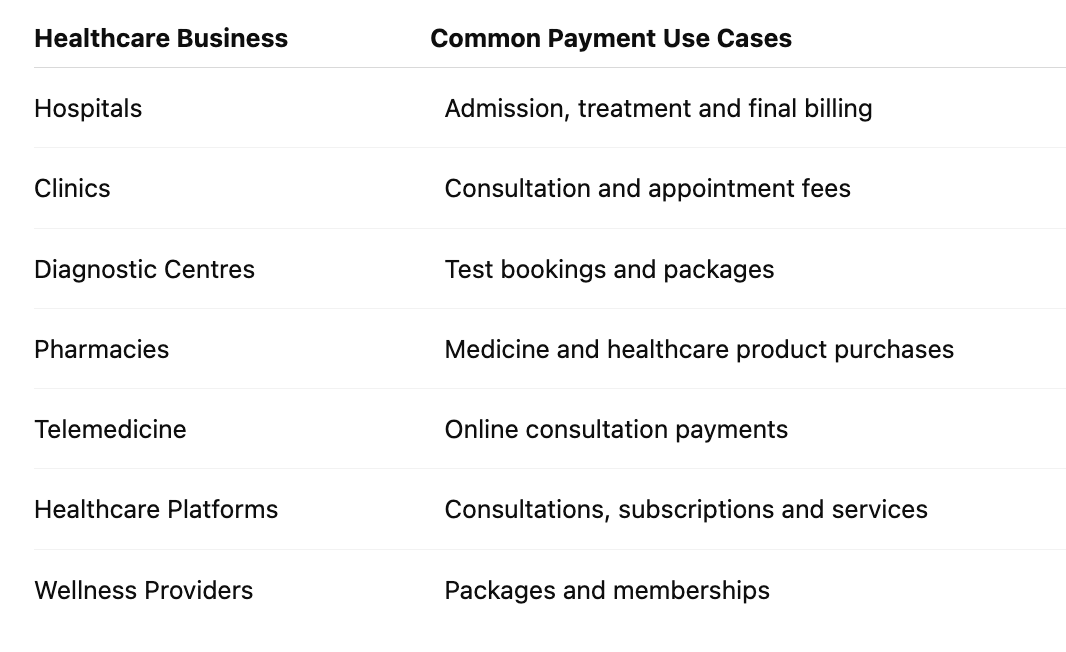
This flexibility is particularly useful for healthcare businesses that are moving from physical payment counters to digital-first patient experiences.
What Payment Challenges Can Healthcare Businesses Avoid?
A well-designed payment setup can help reduce common operational problems such as:
◆ Manual payment confirmation
◆ Long billing queues
◆ Limited payment options
◆ Failed or incomplete transactions
◆ Difficult refund management
◆ Payment-status mismatches
◆ Manual reconciliation
◆ Poor visibility into collections
The payment gateway becomes an important part of the overall patient experience rather than simply a transaction-processing tool.
Final Thoughts
For hospitals, clinics, and healthcare platforms, payments are an important part of the patient journey. The right payment gateway can make collections easier, reduce manual work, and create a smoother digital payment experience.
As healthcare becomes increasingly digital, payment infrastructure needs to be secure, reliable, flexible, and ready to scale.
Looking to simplify healthcare payments? Explore Toucan’s payment solutions to build a smoother and more reliable payment experience for patients and healthcare businesses.
Frequently Asked Questions
Q1. What is a payment gateway for healthcare?
A: A healthcare payment gateway allows hospitals, clinics, diagnostic centres, and healthcare platforms to securely collect digital payments from patients.
Q2. Why do hospitals and clinics need a payment gateway?
A: A payment gateway helps healthcare providers collect payments digitally for consultations, appointments, diagnostics, hospital bills, pharmacy purchases, and other services while reducing manual payment handling.
Q3. How can a payment gateway integrate with hospital or clinic software?
A: Payment gateways can integrate with Hospital Management Systems, EMR/EHR platforms, appointment systems, patient portals, and healthcare apps through APIs and webhooks.
Q4. What payment methods can healthcare businesses accept through a payment gateway?
A: Depending on the provider, healthcare businesses can accept UPI, credit and debit cards, net banking, wallets, EMI, and other payment methods.
Q5. What should hospitals consider when choosing a payment gateway?
A: Hospitals should consider security, payment-method coverage, system integration, payment reliability, refunds, reconciliation, scalability, reporting, and technical support.