What Affects Your Payment Gateway MDR? 7 Factors Merchants Should Know
Introduction
For merchants accepting online payments, the payment gateway MDR is an important part of the overall cost of processing transactions.
MDR, or Merchant Discount Rate, is the fee charged for processing a digital payment. It can affect the cost of every transaction and therefore have a direct impact on a business’s payment expenses and margins.
However, MDR is not always the same for every merchant.
Two businesses using the same payment gateway may receive different pricing depending on factors such as transaction volume, payment method, business category, risk profile, and other commercial considerations.
Understanding what affects your payment gateway MDR can help you evaluate pricing more effectively and identify where there may be opportunities to optimize payment costs.
What Is Payment Gateway MDR?
Merchant Discount Rate is the fee associated with processing a payment transaction.
When a customer makes an online payment, the transaction typically involves several parties, including the merchant, payment gateway, acquiring bank, card network, and issuing bank.
The MDR charged to the merchant can reflect costs associated with processing and facilitating the transaction.
For example, if a merchant processes a transaction of ₹10,000 and the applicable MDR is 2%, the processing fee would be ₹200 before considering applicable taxes or other charges.
The actual pricing structure can vary depending on the payment provider, payment method, merchant agreement, and transaction type.
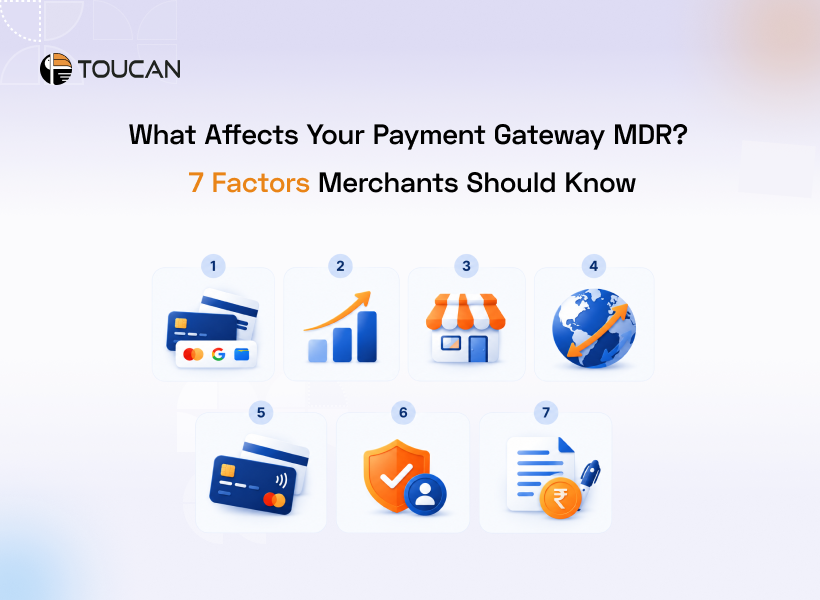
What Factors Affect Payment Gateway MDR?
1. Payment Method
The payment method used by the customer is one of the most important factors affecting payment processing costs.
Cards, UPI, net banking, wallets, and other payment methods can have different pricing structures.
Even within card payments, pricing can vary based on the card type and transaction characteristics.
For merchants, this means that the average MDR across all transactions may be more useful to track than looking at the rate for one payment method alone.
2. Transaction Volume
Payment providers may consider how much transaction volume a merchant processes when determining commercial pricing.
A business processing a high volume of transactions may have more scope to negotiate pricing compared with a small business with limited transaction volumes.
For example, an enterprise processing several crores in monthly online payments may have a different commercial arrangement from a small business processing a few lakh rupees.
However, volume is only one part of the pricing decision.
3. Business Category
The type of business accepting payments can also influence MDR.
Different industries can have different transaction patterns, refund rates, chargeback risks, and operational requirements.
For example, an ecommerce business, educational institution, travel company, subscription business, and financial services company may have different payment requirements and risk profiles.
Payment providers may consider these factors when creating merchant pricing.
4. Domestic vs International Transactions
The location of the customer and the nature of the transaction can affect payment processing costs.
Domestic transactions and international transactions may follow different processing and pricing structures.
International payments can involve additional considerations such as currency conversion, cross border processing, international card networks, and foreign exchange costs.
Merchants accepting payments from customers outside India should therefore evaluate the complete cost of international payment acceptance rather than looking only at the headline MDR.
5. Card Type and Transaction Characteristics
Card transactions are not always priced identically.
Factors such as card category, issuing country, transaction type, and payment network can influence the underlying processing economics.
For example, a merchant may see different costs for domestic and international cards or for different categories of cards.
This is why merchants should understand how their payment provider calculates pricing across different transaction types.
6. Merchant Risk Profile
Risk is another factor that payment providers may consider when determining commercial terms.
Businesses with higher transaction risk, higher chargeback rates, unusual transaction patterns, or certain business models may receive different pricing or additional requirements.
Payment providers may evaluate factors such as:
✦ Business category
✦ Transaction history
✦ Chargeback levels
✦ Refund patterns
✦ Average transaction value
✦ Customer location
✦ Fraud risk
Maintaining good transaction quality and strong fraud prevention practices can therefore be important not only for payment security but also for overall payment operations.
7. Negotiated Commercial Terms
MDR is not always a fixed rate.
For larger merchants, enterprises, marketplaces, and businesses with significant transaction volumes, payment pricing may be commercially negotiated.
Merchants may negotiate based on expected transaction volume, payment method mix, business relationship, contract duration, and other commercial factors.
However, businesses should avoid choosing a payment gateway based only on the lowest MDR.
A lower rate may not necessarily result in a lower overall payment cost if the provider has weaker payment success rates, limited payment methods, poor reporting, or higher operational costs.
How Does MDR Affect Your Business?
MDR directly contributes to the cost of accepting digital payments.
Consider a business processing ₹1 crore in monthly transactions.
At an average MDR of 2%, the payment processing fee would be ₹2 lakh before applicable taxes and other charges.
If the business can reduce its effective processing cost by even a small percentage while maintaining payment performance, the savings can become significant at higher transaction volumes.
This is why merchants should track their effective payment processing cost, rather than looking only at the advertised MDR.
How Can Merchants Optimize Payment Costs?
Reducing payment costs does not always mean negotiating for the lowest possible MDR.
Merchants should also consider:
1. Compare Multiple Providers: Evaluate pricing across different payment providers based on your actual payment mix and transaction volume.
2: Analyze Payment Method Mix: Understand which payment methods customers use most frequently and what each method costs.
3: Monitor Payment Success Rates: A slightly higher MDR may be commercially worthwhile if a provider delivers stronger payment success rates and reduces lost transactions.
4: Review International Payment Costs: If you accept international payments, evaluate currency conversion, cross border charges, and other applicable costs alongside MDR.
5: Reduce Payment Failures: Failed transactions can result in lost revenue. Better payment routing, retry capabilities, and optimized checkout experiences can help improve overall payment performance.
6: Negotiate Based on Volume: As transaction volumes grow, review your commercial agreement and determine whether your payment pricing still reflects your current scale.
MDR vs Overall Payment Cost
One important point for merchants is that MDR is only one part of the total cost of accepting payments.
Businesses should also consider applicable taxes, refunds, chargebacks, currency conversion, settlement charges, platform fees, and other costs depending on their payment setup.
This means the cheapest advertised MDR may not always represent the lowest total cost.
A better approach is to calculate the effective cost of payment acceptance across your complete transaction lifecycle.
Final Thoughts
Payment gateway MDR depends on several factors, including payment method, transaction volume, business category, transaction geography, card type, risk profile, and negotiated commercial terms.
For merchants, the goal should not simply be to find the lowest MDR.
The better approach is to evaluate cost alongside payment success rates, security, payment method coverage, reporting, settlement, and overall customer experience.
As transaction volumes grow, regularly reviewing your payment economics can help identify opportunities to reduce costs while maintaining a reliable payment experience.
Explore ToucanPay’s payment gateway solutions to find the right fit for your business.
Frequently Asked Questions
Q1: What is MDR in payment gateways?
A: MDR stands for Merchant Discount Rate. It is the fee associated with processing a digital payment and is generally charged to the merchant.
Q2: What factors affect payment gateway MDR?
A: Payment method, transaction volume, business category, domestic or international transactions, card type, merchant risk profile, and negotiated commercial terms can all influence MDR.
Q3: Is a lower MDR always better?
A: Not necessarily. Merchants should consider MDR alongside payment success rates, transaction reliability, payment methods, settlement, security, and other payment related costs.
Q4: Can merchants negotiate payment gateway MDR?
A: Depending on the provider and commercial arrangement, businesses with significant transaction volumes may be able to negotiate pricing based on factors such as transaction volume, payment mix, and business requirements.
Q5: Does transaction volume affect MDR?
A: Transaction volume can influence commercial pricing. Businesses processing higher transaction volumes may have greater scope to negotiate payment processing rates.
Q6: Is MDR the same for all payment methods?
A: No. Different payment methods and transaction types can have different pricing structures. Merchants should evaluate their actual payment mix when calculating their effective payment processing cost.