How SaaS Companies Can Track International Customer Payments Across Multiple Markets
As SaaS companies expand into international markets, managing customer payments becomes more complex. A business may collect subscription fees in US dollars, euros and British pounds while using different payment providers across regions.
The challenge is not just accepting payments. Businesses also need to track successful transactions, monitor processing fees, manage currency conversions and confirm when funds reach their accounts.
A structured payment tracking process helps SaaS companies maintain financial visibility and manage international transactions more efficiently.
Why Is Tracking International Payments Challenging?
Managing payments across multiple markets introduces a few common challenges:
- Multiple currencies: Customers pay in different currencies, while businesses may report revenue in one base currency.
- Different payment providers: Each provider has its own transaction reports, references and settlement timelines.
- Payment status differences: An approved payment does not always mean the funds have reached the business account.
- Currency conversion fees: Exchange rates and processing charges affect the final amount received.
- Manual reconciliation: Finance teams spend time matching transactions with invoices and bank deposits.
Without a consistent tracking process, identifying missing payments and understanding revenue differences becomes difficult.
5 Ways SaaS Companies Can Track International Payments
Learn how to track, manage, reconcile and optimise international payments across multiple markets.
1. Centralise Payment Data
Start by bringing payment information from your payment gateways, billing platform and subscription system into one reporting view.
Maintain important transaction details such as customer ID, invoice number, payment provider, country, currency, transaction reference and payment status.
A centralised view helps teams quickly identify who paid, which invoice the transaction belongs to and whether the payment was successful, refunded or disputed.
2. Track Payments From Checkout to Settlement
A payment passes through several stages before the money reaches your business account.
For example, a customer in the US pays $100 for a SaaS subscription. The payment is approved, captured and later included in a provider payout. Processing fees and currency conversion may affect the final amount received.
Track each stage:
- Authorisation: Was the payment approved?
- Capture: Was the payment collected?
- Settlement: Has the transaction been processed for settlement?
- Payout: Were the funds sent to your business account?
- Reconciliation: Does the payout match your transaction records?
3. Monitor Multiple Currencies and Processing Fees
International payment reporting should show both the original transaction currency and the amount recorded in your reporting currency.
For example, a customer may pay €100 while your business reports revenue in US dollars. The exchange rate, conversion charges and settlement terms affect the final amount.
Keep separate records of:
- Original transaction amount and currency
- Conversion rate, where applicable
- Processing and conversion fees
- Settlement currency and net payout
This helps businesses understand the actual cost of collecting payments across different markets.
4. Automate Payment Reconciliation
Payment reconciliation involves matching transaction records with invoices, provider reports and bank deposits.
As transaction volumes grow, manual reconciliation becomes time-consuming. Automating this process can help identify unmatched transactions, duplicate records, unexpected fees and settlement differences.
For SaaS companies, this is particularly useful when recurring subscriptions, one-time payments, refunds and chargebacks appear in different reports.
A consistent reconciliation process also helps finance teams prepare accurate financial reports and close their books more efficiently.
5. Compare Payment Performance Across Markets
Payment tracking should also help businesses understand how their payment setup performs in different regions.
Monitor these key metrics:
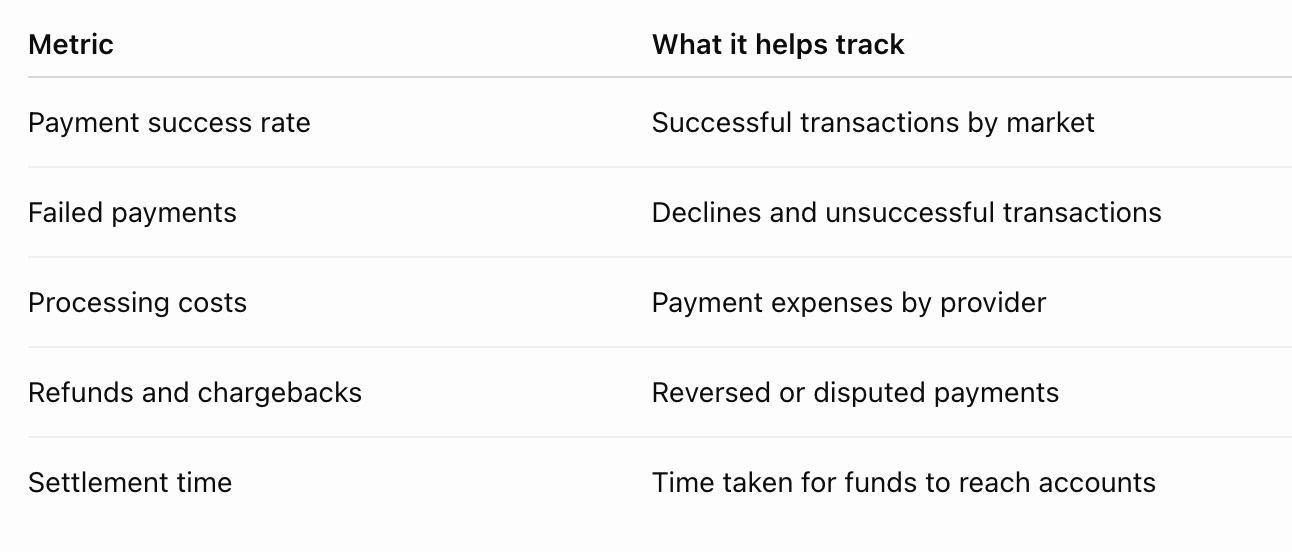 For example, if payment success rates are consistently lower in one region, investigate local payment preferences, provider performance and authentication requirements.
These insights help businesses identify where their payment experience needs improvement.
How Payment Orchestration Improves International Payment Visibility
When SaaS companies work with multiple payment providers, managing separate dashboards and reports can become difficult.
Payment orchestration provides a central layer to coordinate payment providers, manage transaction routing and monitor payment activity.
Depending on the platform, it can help businesses:
- View transaction activity across connected providers.
- Apply routing rules based on market or payment method.
- Compare provider performance.
- Standardise transaction data for reporting.
- Simplify payment reconciliation.
This gives finance and payment teams better visibility without relying entirely on separate provider dashboards.
Final Thoughts
Tracking international customer payments is essential for SaaS companies expanding across multiple markets. Centralised transaction data, multi-currency reporting, automated reconciliation and payment analytics help businesses maintain financial visibility and reduce manual work.
Expanding your SaaS business globally? Explore how Toucan Payments‘ payment orchestration capabilities can help simplify payment management across providers and markets.
Frequently Asked Questions
Q1. What is international payment tracking?
A: It is the process of monitoring customer payments from initiation through settlement, payout and reconciliation across different countries and currencies.
Q2. Why do SaaS companies need multi-currency reporting?
A: It helps businesses track original payment amounts, currency conversions, processing fees and final payouts accurately.
Q3. How can SaaS businesses automate payment reconciliation?
A: By connecting payment provider reports with billing, accounting and bank records to match transactions and identify discrepancies.
Q4. What is the role of payment orchestration in international payments?
A: It coordinates multiple payment providers and transaction flows, helping businesses improve payment visibility and manage routing.
Q5. Which payment metrics should SaaS companies track?
A: Payment success rates, failed transactions, processing costs, refunds, chargebacks and settlement times are important metrics to monitor.