Payment Orchestration for Subscription Businesses: Managing Renewals and Payment Recovery
A subscription payment fails. The customer still wants your service, but their card has expired or their bank has declined the transaction. If the payment is not recovered, your business could lose recurring revenue and a customer who never intended to cancel.
For subscription businesses, managing recurring payments is about more than collecting money on time. It also means handling failed transactions, reducing payment-related churn and keeping the customer experience smooth.
This is where payment orchestration can help by connecting payment providers and coordinating payment flows, retries and routing strategies.
Why Do Subscription Payments Fail?
Recurring payments can fail for several reasons:
1. Expired or replaced cards: The saved payment details are no longer valid.
2. Insufficient funds: The customer does not have enough available balance.
3. Bank declines: The issuing bank rejects a transaction for risk or other reasons.
4. Technical issues: Network errors or provider downtime interrupt payment processing.
5. Authentication requirements: Some payments need additional customer verification.
Not every failed payment can be recovered automatically. Understanding why a transaction failed helps businesses decide whether to retry, request updated details or use another permitted payment method.
How Does Payment Orchestration Help Subscription Businesses?
Payment orchestration connects payment providers through a central layer, helping businesses manage payment routing, transaction visibility and provider integrations.
For subscription businesses, it can support three important areas.
1. Smarter Payment Routing
If a business works with multiple payment providers, orchestration can route eligible transactions according to configured rules, such as payment method, geography, provider availability or transaction requirements.
This can help businesses manage provider dependencies and improve payment continuity. However, routing a failed payment to another provider does not guarantee success, particularly when the underlying issue is an expired card or insufficient funds.
2. Better Renewal Management
Subscriptions require payments at regular intervals, making consistent processing essential.
An orchestration layer can help coordinate renewal transactions across supported providers and provide visibility into payment outcomes. This makes it easier for teams to identify recurring failures and investigate problems affecting particular payment methods or markets.
3. More Effective Payment Recovery
When a renewal fails, businesses need to decide what happens next. Depending on the decline reason and provider capabilities, the next action might be a scheduled retry, a customer notification or a request to update payment details.
Payment orchestration can help coordinate these workflows, while billing or subscription management systems may handle the retry schedules and customer communication.
Best Practices for Managing Renewals and Failed Payments
Learn how to streamline renewals, recover failed payments, and minimise subscription cancellations.
Avoid retrying every failed transaction in the same way. Temporary issues may resolve over time, while permanent declines usually require customer action. Use provider-supported decline information to determine the appropriate next step.
2. Notify customers at the right time
Send clear payment failure notifications with a secure way to update payment details or complete any required authentication. Stop reminders once payment succeeds.
3. Use fallback providers carefully
Where supported, configure routing rules to direct eligible transactions to an alternative provider if the primary provider is unavailable or a particular transaction cannot be processed. Avoid unnecessary duplicate payment attempts.
4. Monitor payment performance
Track renewal success rates, failed payment reasons, recovered transactions and payment-related subscription cancellations. These metrics help identify where improvements are needed.
5. Protect customer data
Use secure tokenisation and approved payment data migration processes. Keep credentials protected and follow applicable security, authentication and regulatory requirements.
How to Measure Payment Recovery Performance
Subscription businesses should look beyond total transaction volume when evaluating payment performance.
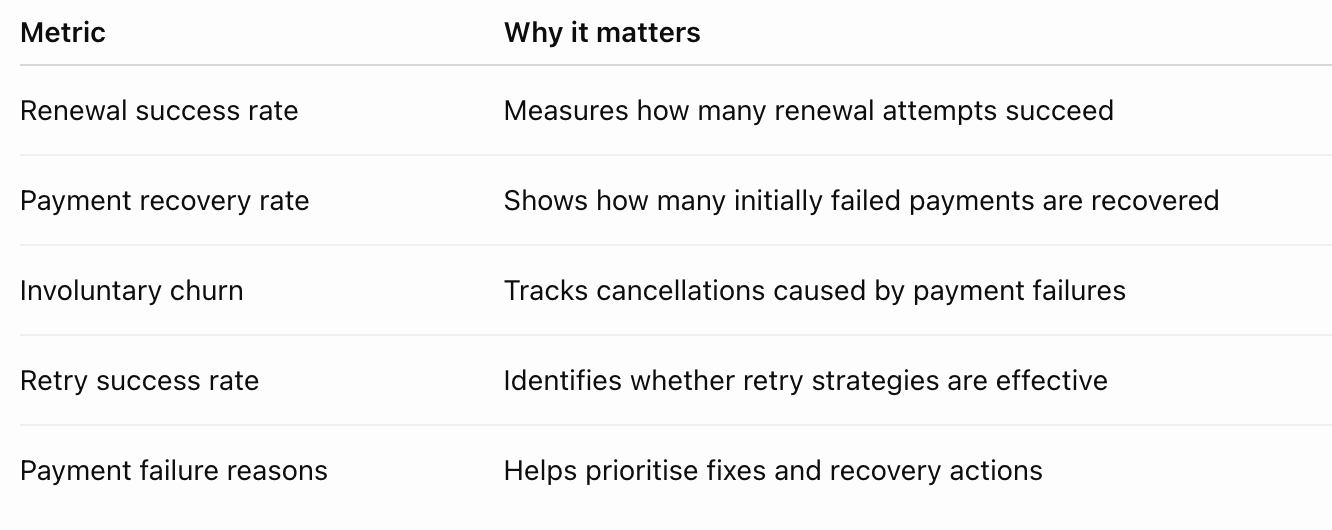 Review these metrics regularly and compare performance across providers, markets and payment methods where possible.
Final Thougths
Payment orchestration can help subscription businesses coordinate providers, manage recurring payment flows and improve visibility into failed renewals. Combined with suitable retry strategies and timely customer communication, it can support better payment recovery and reduce avoidable subscription loss.
Looking to simplify recurring payment operations? Explore how Toucan Payments’ payment orchestration capabilities can help your business manage payment flows and build a more flexible payment infrastructure.
Frequently Asked Questions
Q1. What is payment orchestration for subscription businesses?
A: It connects and coordinates payment providers and workflows to help businesses manage recurring transactions, routing and payment performance.
Q2. Can payment orchestration recover failed subscription payments?
A: It can support recovery through routing and coordinated workflows, depending on the setup. Some failures require customers to update their payment details or complete authentication.
Q3. What is the difference between payment orchestration and payment retry management?
A: Payment orchestration coordinates payment providers and transaction flows. Retry management determines when and how eligible failed payments are attempted again.
Q4. How can businesses reduce involuntary churn?
A: Use suitable retry schedules, notify customers about failed payments, offer secure payment update options and monitor recovery performance.
Q5. Is payment orchestration useful for SaaS and membership businesses?
A: Yes. SaaS platforms, membership services and other subscription businesses can benefit from managing recurring payments across providers, particularly as transaction volumes and market requirements grow.