School ERP + Payment Gateway Integration: Everything You Need to Know
Introduction
Managing school fee collection can be time-consuming, especially when payment records and the School ERP are managed separately. Finance teams may have to verify transactions manually, update student records, reconcile payments, and generate receipts.
Integrating a payment gateway with a School ERP connects these processes. When a parent pays online, the payment status can automatically flow back to the ERP, helping update fee records, generate receipts, and simplify reconciliation.
In this guide, we’ll explain how School ERP and payment gateway integration works, its key benefits, and what schools should consider when choosing a payment solution.
What Is School ERP and Payment Gateway Integration?
A School ERP manages key academic and administrative activities such as student records, admissions, attendance, examinations, and fee management.
A payment gateway enables schools to accept online payments through methods such as UPI, cards, net banking, and other supported payment options.
When both systems are integrated, payment information can move automatically between the payment gateway and ERP. This means schools don’t have to manually update every successful transaction.
For parents, it creates a simpler way to pay fees and receive confirmation. For schools, it helps reduce manual payment-related work.
How Does School ERP Payment Gateway Integration Work?
The process generally follows these steps:
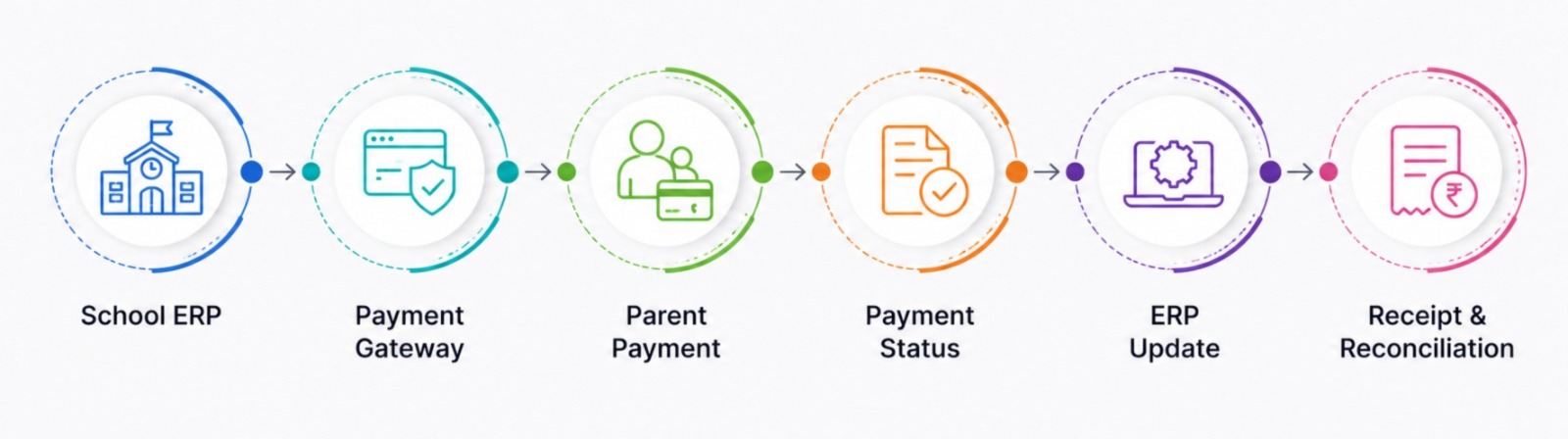
1. Fee is generated: The student’s outstanding fee is available in the School ERP or parent portal.
2. Payment is initiated: The parent selects the online payment option and proceeds to the payment gateway.
3. Payment is processed: The parent completes the transaction using the available payment method.
4. Status is communicated: The payment gateway sends the transaction status back to the ERP through APIs or webhooks.
5. ERP is updated: The student’s payment record is updated based on the transaction status.
6. Receipt is generated: A digital receipt can be generated and the transaction becomes available for reconciliation and reporting.
This connected workflow reduces the need for finance teams to manually verify and enter payment information.
Why Do Schools Need ERP and Payment Gateway Integration
When payment collection is handled separately from the ERP, schools can face challenges such as:
◆ Manual reconciliation
◆ Delayed payment verification
◆ Duplicate data entry
◆ Difficulty tracking pending or failed payments
◆ Manual receipt generation
◆ Higher workload during admission and fee cycles
◆ Integrating the payment gateway with the ERP brings payment collection closer to the school’s existing fee management workflow.
Key Benefits of School ERP + Payment Gateway Integration
1. Automated Fee Collection: Parents can pay fees online without visiting the school’s fee counter. Successful payment information can be automatically passed to the ERP.
2. Faster Reconciliation: Payment transactions can be matched with student or fee records, reducing the time finance teams spend comparing payment data manually.
3. Real-Time Payment Visibility: Finance teams can quickly see successful, pending, or failed transactions and follow up when required.
4. Digital Receipts: Successful payments can trigger digital receipts, giving parents immediate confirmation while reducing manual receipt generation.
5. Better Parent Experience: Parents can pay from anywhere, use their preferred payment method, and access payment confirmation without relying on manual updates from the school.
6. Simpler Reporting: With payment information connected to the ERP, schools can get a clearer view of collections, outstanding fees, and transaction activity.
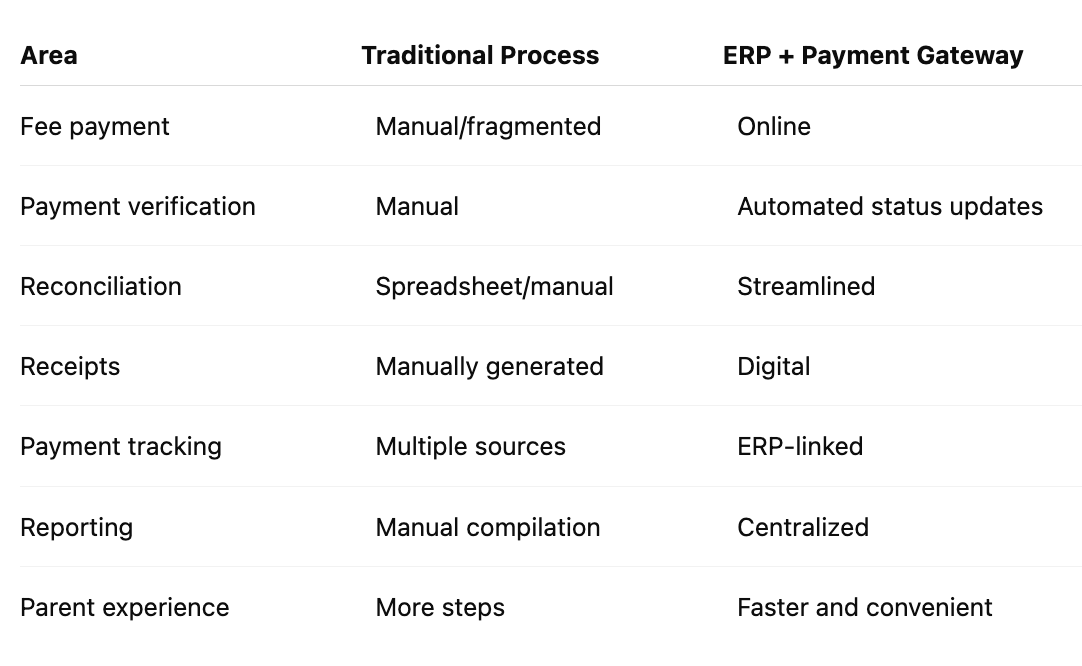
Traditional Fee Collection vs. ERP-Integrated Payments
What Should Schools Look for in a Payment Gateway?
The right solution should not only accept payments but also integrate smoothly with the school’s existing systems.
Key considerations include:
1.API and webhook support: Enables communication between the ERP and payment gateway.
2.Payment method coverage: Supports relevant methods such as UPI, cards, and net banking.
3.Automated reconciliation: Helps match transactions with student or fee records.
4.Refund support: Makes it easier to manage eligible refunds and adjustments.
5.Payment status tracking: Clearly identifies successful, failed, and pending transactions.
6.Security and compliance: Payment processing should follow appropriate security practices and applicable compliance requirements.
7.Scalability: The solution should handle higher transaction volumes during admissions and fee deadlines.
Is School ERP Payment Gateway Integration Secure?
Security is important because schools handle both payment transactions and student-related information.
A reliable payment integration should use measures such as encryption, secure API authentication, tokenization where applicable, access controls, and PCI DSS-compliant payment processing where relevant.
Schools should also evaluate the security practices of both their ERP provider and payment gateway before implementation.
How ToucanPay Simplifies School Fee Collection
ToucanPay helps educational institutions modernize their fee collection by connecting payment capabilities with existing systems and workflows.
With support for multiple payment methods, payment status updates, reconciliation workflows, digital payment confirmation, refunds, and reporting, ToucanPay can help schools reduce manual payment-related work while creating a smoother experience for parents.
Whether you’re managing a school, college, coaching institute, or EdTech platform, an integrated payment setup can help simplify fee collection and improve operational visibility.
Final Thoughts
School ERP and payment gateway integration can turn fee collection from a fragmented, manual process into a more connected workflow.
By linking payments with the ERP, schools can simplify reconciliation, improve payment visibility, provide digital receipts, and make fee payments more convenient for parents.
The right solution should fit into the school’s existing systems while providing the security, payment options, and integration capabilities needed to support growing digital fee collection.
Looking to simplify online fee collection and ERP payment integration? Talk to the ToucanPay team to explore the right setup for your institution.
Frequently Asked Questions
Q1. What is School ERP and payment gateway integration?
A: It is the process of connecting a School ERP with a payment gateway so online fee payments can be processed and payment information can be automatically updated in the ERP.
Q2.Why should schools integrate their ERP with a payment gateway?
A: Integration helps reduce manual reconciliation, improve payment tracking, automate receipts, and provide parents with a more convenient way to pay fees.
Q3.Can parents pay school fees using UPI and cards?
A: Yes. Depending on the payment gateway, schools can offer payment methods such as UPI, debit cards, credit cards, and net banking.
Q4.How does the payment gateway update the ERP?
A: Payment gateways can use APIs and webhooks to send transaction information and payment status back to the School ERP.
Q5.Can an existing School ERP be integrated with a payment gateway?
A:Yes. Many modern payment gateways provide APIs and integration capabilities that can connect with existing ERP platforms, depending on the ERP’s technical setup.
Q6.Can schools automate fee reconciliation?
A: Yes. Payment data can be linked with student or fee records, helping finance teams reduce manual reconciliation work.