Cart Abandonment: Why Customers Leave Checkout and How to Reduce It
Introduction
Cart abandonment happens when a customer adds products to their cart but leaves the website or app before completing the purchase. Getting a customer to add a product to their cart is a positive sign, but the journey is not complete until the payment goes through.
A customer may browse products, compare options, add items to their cart, and reach checkout with every intention of buying, only to leave without completing the purchase. Cart abandonment is one of the most common challenges faced by ecommerce businesses.
Not every abandoned cart can be prevented. Customers may simply change their minds or decide not to buy. However, a complicated checkout process, limited payment options, unexpected costs, or payment failures can create unnecessary friction.
This is where a well-designed checkout experience and reliable payment gateway can make a difference.
What Is Cart Abandonment?
Cart abandonment occurs when a customer adds one or more products to their online shopping cart but leaves the website or app before completing the purchase.
For example, a customer may select a product, proceed to checkout, enter their details, and then encounter a failed payment or an unfamiliar payment option. Instead of trying again, they may simply leave.
For ecommerce businesses, these incomplete purchases represent potential revenue that can be difficult to recover.
Why Do Customers Abandon Checkout?
Customers abandon checkout for many reasons, but most come down to friction, uncertainty, or payment issues.
1. Unexpected costs: Extra shipping fees, taxes, or charges appearing at the final step can make customers reconsider.
2. Complicated checkout: Too many fields, pages, or mandatory account creation can make the process feel unnecessarily long.
3. Limited payment options: Customers may leave if their preferred option, such as UPI, cards, or net banking, isn’t available.
4. Payment failures: Bank issues, technical errors, authentication problems, or network interruptions can stop an otherwise ready customer from completing the purchase.
5. Lack of trust: An unfamiliar or poorly designed payment page can make customers hesitant to enter financial information.
6. Poor mobile experience: Slow-loading pages, difficult forms, or an unresponsive checkout can lead to drop-offs, especially on smartphones.
How Payment Gateways Can Help Reduce Cart Abandonment
A payment gateway cannot solve every checkout problem, but it can reduce payment-related friction at the most important stage of the customer journey.
1. Multiple payment methods: Support options such as UPI, cards, net banking, and wallets so customers can pay their preferred way.
2. Faster checkout: A streamlined payment flow reduces unnecessary steps between selecting a payment method and completing the transaction.
3. Better payment reliability: Routing, retries, and connections with payment partners can help improve transaction success.
4. Clear payment status: Customers should immediately know whether their payment was successful, failed, or is still processing.
5. Easy payment recovery: Simple retry options can give customers another chance to complete a failed transaction instead of abandoning the purchase.
6. Smooth refunds: Efficient refund processing helps resolve payment-related issues and builds confidence for future purchases.
Cart Abandonment: Checkout Problem or Payment Problem?
It’s important to distinguish between checkout friction and payment friction.
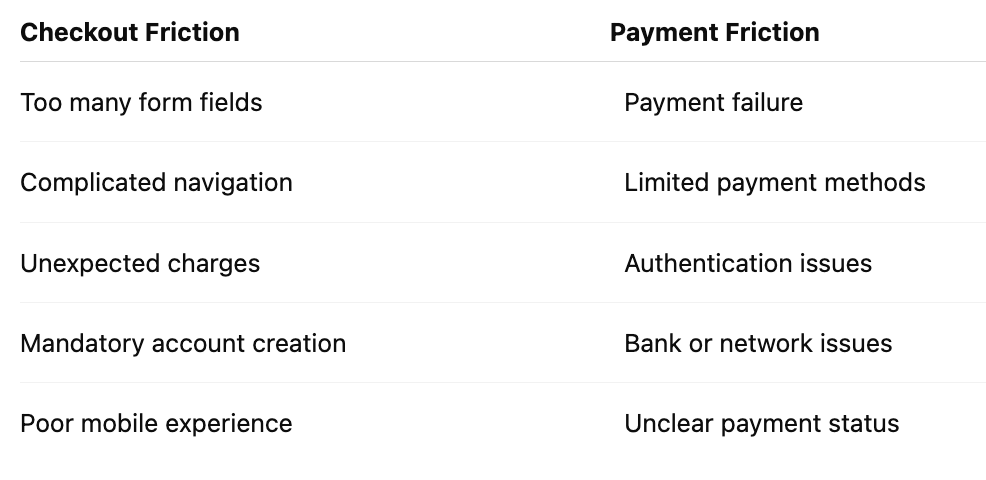 A payment gateway can primarily address payment-related friction, but reducing cart abandonment requires businesses to optimize the entire checkout journey.
How Ecommerce Businesses Can Reduce Checkout Abandonment
Payment infrastructure is only one part of the solution. Businesses should also review the complete customer journey.
Consider these practices:
◆ Show the total order cost clearly.
◆ Keep checkout steps to a minimum.
◆ Offer commonly used payment methods.
◆ Optimize checkout for mobile devices.
◆ Clearly communicate payment status.
◆ Make retrying failed payments simple.
◆ Avoid unnecessary account creation.
◆ Display relevant security information.
◆ Provide easy access to customer support.
◆ Track where customers are dropping off.
Analytics can help businesses identify whether customers are leaving because of checkout design, payment failures, unexpected costs, or another issue.
Final Thoughts
Cart abandonment is not always a payment problem. Customers can leave because of pricing, shipping costs, product decisions, or a complicated checkout process. However, payment friction is one area ecommerce businesses can actively improve.
A reliable payment gateway can make checkout more convenient by supporting relevant payment methods, improving transaction reliability, providing clear payment status, and simplifying payment-related issues.
The goal isn’t simply to give customers more ways to pay. It’s to create a checkout experience where customers can move from “I want this” to “my order is confirmed” with as little friction as possible.
Ready to create a smoother payment experience for your ecommerce business?
Frequently Asked Questions
Q1: What is the biggest reason customers abandon checkout?
A: There is no single reason. Common causes include unexpected costs, complicated checkout processes, limited payment options, payment failures, security concerns, and poor mobile experiences.
Q2: Can a payment gateway reduce cart abandonment?
A: Yes, a payment gateway can help reduce payment-related abandonment by offering relevant payment methods, supporting reliable transaction processing, providing clear payment status, and simplifying failed-payment recovery.
Q3: How do payment failures affect cart abandonment?
A: A failed payment can interrupt an otherwise successful purchase journey. If customers cannot easily retry the transaction or understand what happened, they may leave without completing their order.
Q4: Do multiple payment options reduce cart abandonment?
A: Offering relevant payment options can reduce friction for customers who prefer specific methods such as UPI, cards, or net banking. However, payment options should be selected based on the target audience rather than simply offering as many methods as possible.
Q5: How can ecommerce businesses reduce checkout abandonment?
A: Businesses can simplify checkout, show costs transparently, optimize the mobile experience, offer relevant payment methods, reduce payment failures, and use analytics to identify where customers are dropping off.