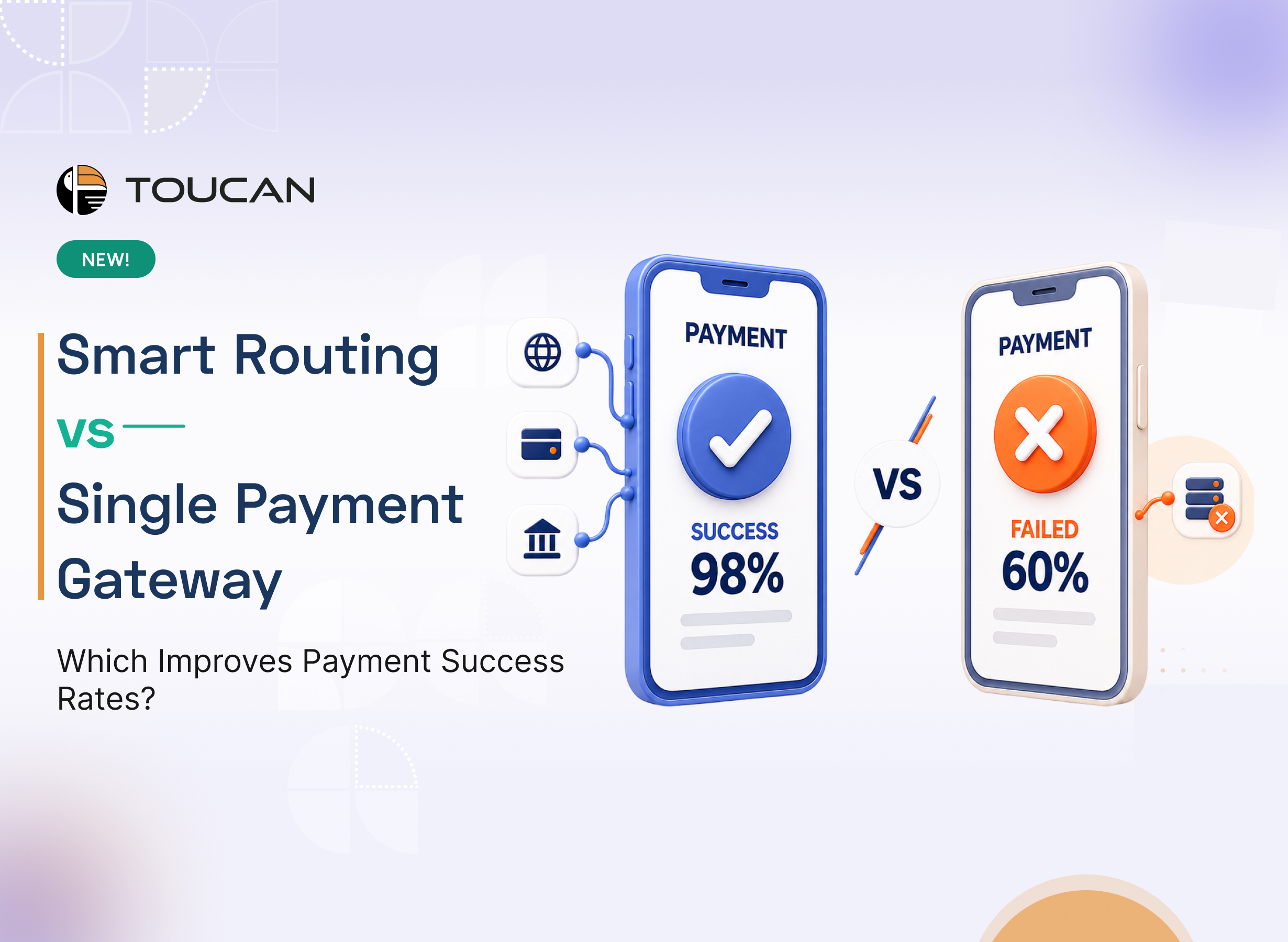
Smart Routing vs Single Payment Gateway: Which Improves Payment Success Rates?
Introduction
A payment failure can mean more than a failed transaction. It can lead to a lost sale, abandoned checkout, or frustrated customer.
As payment volumes, methods, currencies, and markets grow, businesses need to look beyond simply asking, “Which payment gateway should I use?”
The bigger question is: Should you rely on one gateway or use smart payment routing across multiple providers?
Let’s compare both approaches and understand which model makes sense for growing businesses.
What Is a Single Payment Gateway?
A single payment gateway provides one primary route for processing online payments.
The basic flow looks like:
Customer → Payment Gateway → Processor/Bank → Payment Result
For many businesses, this approach is attractive because it offers:
◆ One integration
◆ Simpler payment management
◆ One primary payment provider
◆ Easier initial implementation
If the gateway performs consistently and the business has limited payment requirements, there may be little reason to add additional complexity.
The challenge is dependency.
If the gateway experiences downtime, performance issues, or problems with a particular payment method or transaction type, the merchant may have limited alternatives.
What Is Smart Payment Routing?
Smart payment routing allows businesses to connect with multiple payment processors or gateways and determine where a transaction should be processed.
Instead of sending every transaction through the same route, routing rules can consider factors such as:
◆ Payment method
◆ Transaction amount
◆ Currency
◆ Customer location
◆ Issuing bank
◆ Processor performance
◆ Transaction type
◆ Business rules
The goal is simple: send each transaction through a suitable payment route with the potential to improve the likelihood of successful processing.
This is commonly managed through a payment orchestration platform, which provides a centralized layer between the merchant and multiple payment providers.
Smart Routing vs Single Payment Gateway
A single gateway keeps payments simple, while smart routing gives businesses more flexibility by selecting the best payment route for each transaction.
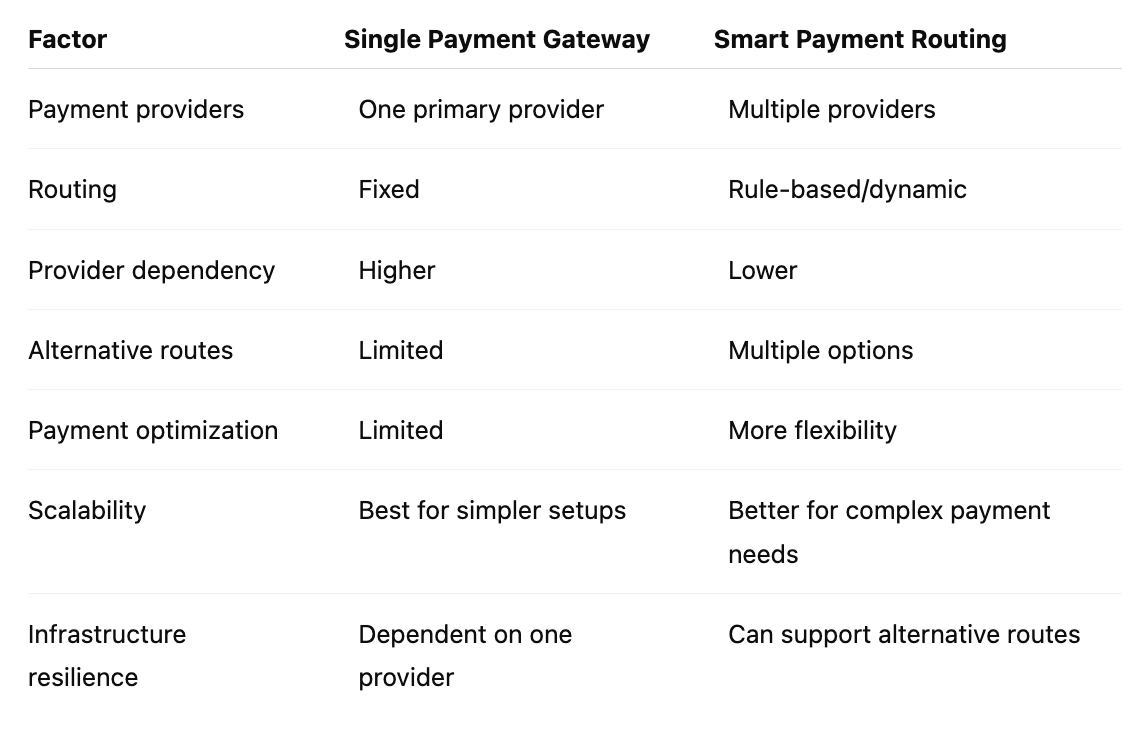
The biggest difference is flexibility.
A single gateway gives you one primary payment path. Smart routing gives you multiple paths and the ability to decide which route should handle a transaction.
How Can Smart Routing Improve Payment Success Rates?
1. Route Transactions Based on Performance
Payment processors may perform differently depending on the payment method, geography, bank, or transaction type.
Smart routing allows merchants to create rules that direct transactions toward a suitable processor based on these conditions.
Instead of treating every transaction the same, merchants can create a more flexible payment flow.
2. Create Alternative Payment Routes
A single gateway can leave a merchant with limited options when a transaction cannot be processed.
With multiple connected providers, businesses can create alternative routes.
For example:
Primary Route → Failure → Alternative Route
Depending on the failure scenario and routing configuration, the transaction can potentially be directed to another available processor.
This can help reduce avoidable payment failures and provide greater infrastructure resilience.
3. Support Multiple Payment Methods
Customers expect payment flexibility.
Cards, UPI, wallets, bank transfers, and other payment methods can have different processing requirements and performance patterns.
A multi-provider payment setup allows businesses to manage a wider payment ecosystem while using routing rules to determine the appropriate processing path.
This becomes particularly important for merchants serving diverse customer segments.
4. Reduce Dependence on One Provider
Relying entirely on one payment provider creates a single point of dependency.
If that provider experiences an outage or performance issue, the impact can extend across the merchant’s transactions.
Smart routing provides access to alternative payment routes, helping businesses build a more resilient payment infrastructure.
5. Support Different Markets
Payment performance can vary across countries, currencies, and payment methods.
A processor that works well for domestic payments may not always be the best option for international transactions.
Smart routing allows businesses to create rules around factors such as:
Country + Currency + Payment Method + Processor
This gives merchants greater control over how payments are processed across different markets.
Is Smart Routing Always Better?
Not necessarily.
A single payment gateway may still be the right choice for businesses with:
◆ Lower transaction volumes
◆ Limited payment methods
◆ One primary market
◆ Simple payment requirements
◆ A gateway that consistently meets their needs
The additional complexity of multiple providers may not be necessary for every business.
However, businesses experiencing recurring payment failures, operating across multiple markets, or managing several payment methods may benefit from a more flexible routing strategy.
How Toucan Helps With Smart Payment Routing
Toucan’s SuperStream Payment Orchestration platform helps businesses connect with multiple payment processors and manage payment routing through a centralized orchestration layer.
Instead of managing separate integrations and routing logic across different providers, businesses can manage their payment infrastructure through one platform.
SuperStream supports capabilities such as:
◆ Smart transaction routing
◆ Multiple payment processor connections
◆ Payment method optimization
◆ Failover capabilities
◆ Tokenization
◆ Fraud prevention
◆ Centralized payment management
◆ Payment performance visibility
Final Thoughts
A payment gateway is a good starting point for accepting healthcare payments. But as hospitals, clinics, and healthcare platforms grow, payment needs become more complex. They need secure processing, reliable collections, easy reconciliation, and a smoother patient payment experience.
The right payment gateway can help simplify these operations while giving healthcare businesses the flexibility to support different payment journeys.
Ready to build a simpler healthcare payment experience? Explore Toucan’s payment solutions to make patient payments more secure, seamless, and scalable.
Frequently Asked Questions
Q1: What is smart payment routing?
A: Smart payment routing determines which payment processor or route should handle a transaction based on factors such as payment method, location, currency, processor performance, and business rules.
Q2: Can smart routing improve payment success rates?
A: It can help improve payment performance by selecting suitable payment routes and providing alternative processing options. Actual results depend on processor performance, routing logic, payment methods, and transaction conditions.
Q3: Is smart routing the same as payment failover?
A: No. Failover primarily provides an alternative route when the primary route fails. Smart routing can proactively select a suitable route based on transaction conditions and business rules.
Q4: Do I need multiple payment gateways for smart routing?
A: Smart routing is most valuable when a business has access to multiple payment processors or gateways. The ideal setup depends on transaction volume, markets, payment methods, and business requirements.