What Features Differentiate Payment Orchestration Platforms From Traditional Gateways?
Introduction
Businesses today have more payment options than ever. Customers can pay using cards, UPI, wallets, bank transfers, and other local payment methods. At the same time, businesses operating across multiple markets often work with different payment service providers and processors.
This creates an important question: What is the difference between a traditional payment gateway and a payment orchestration platform?
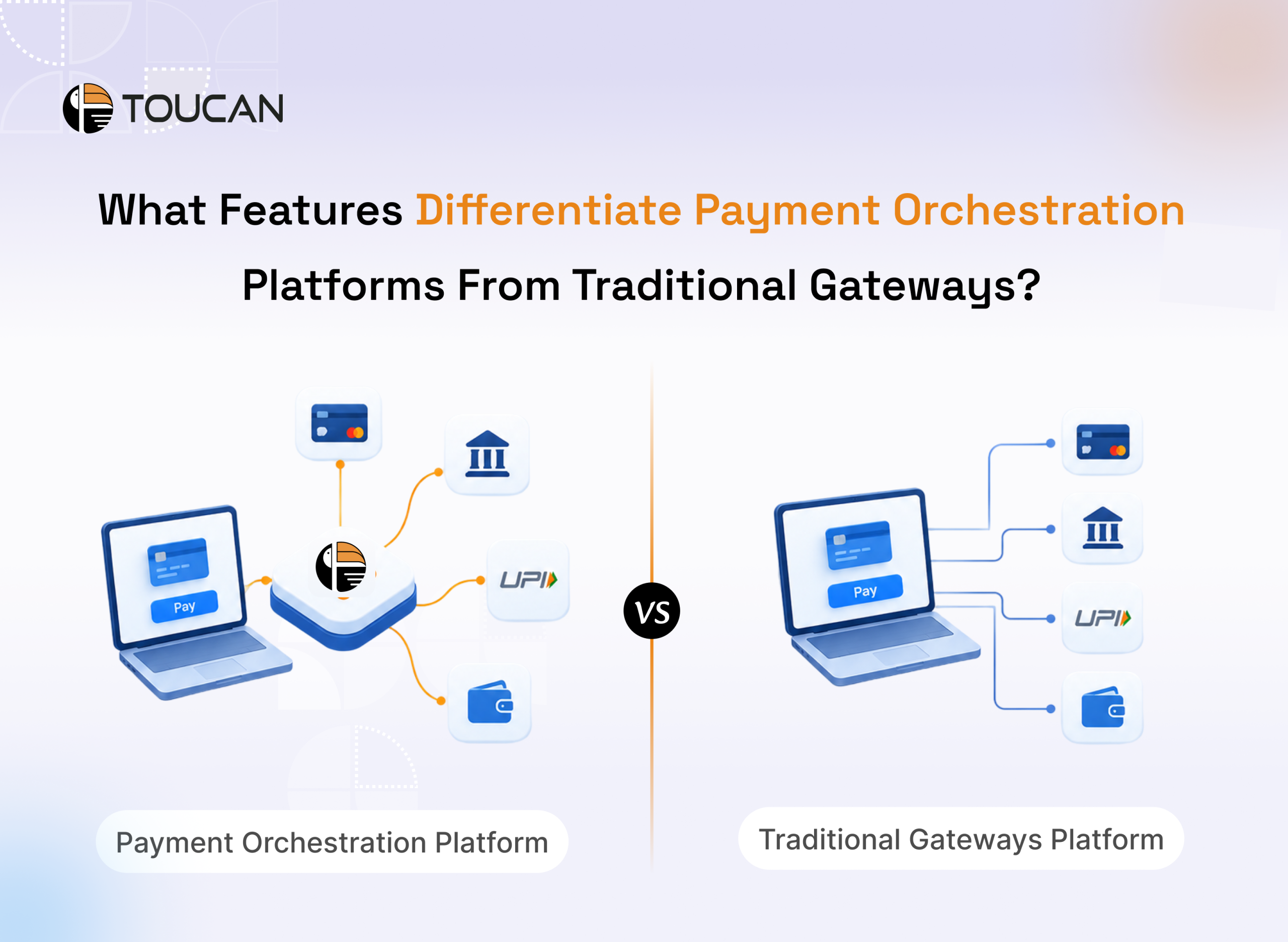
A traditional payment gateway can provide the connection required to accept payments online. Payment orchestration goes a step further by providing a centralized layer for managing multiple payment providers, payment methods, transaction routes, and payment operations.
For a business processing payments at scale, this difference can have a significant impact on flexibility, payment performance, operations, and expansion.
What Is a Traditional Payment Gateway?
A traditional payment gateway connects a merchant with payment processing infrastructure so customers can make payments online.
When a customer selects a payment method, the gateway securely transfers the transaction information for authorization and returns the payment status to the merchant.
For many businesses, a single payment gateway may be enough when they operate in one market and have relatively straightforward payment requirements.
However, as the business grows, it may need more payment providers, additional payment methods, international payment capabilities, better transaction routing, and centralized reporting.
This is where payment orchestration becomes relevant.
What Is Payment Orchestration?
Payment orchestration is a technology layer that connects businesses with multiple payment gateways, processors, acquirers, and payment methods through a centralized infrastructure.
Instead of building and maintaining separate integrations with every provider, businesses can use an orchestration platform to manage multiple payment connections through a unified integration.
The major difference is therefore not simply the number of payment providers supported.
It is the level of control businesses have over their payment infrastructure.
7 Features That Differentiate Payment Orchestration From Traditional Gateways
1. Multi Provider Connectivity
A traditional payment gateway typically connects a business to its own payment processing network. Payment orchestration allows businesses to connect multiple gateways, processors, and acquirers through one integration.
This gives businesses more flexibility to choose providers based on market, payment method, transaction type, or business requirements.
2. Intelligent Payment Routing
Payment orchestration gives businesses greater control over where transactions are processed.
Transactions can be routed based on factors such as payment method, geography, currency, provider performance, or availability. This helps businesses create routing strategies that match their payment requirements.
3. Payment Retry and Failover
When a transaction fails because of a temporary issue with a payment provider, a single gateway may offer limited alternatives.
With multiple providers connected, an orchestration platform can support retry and failover strategies where appropriate. This provides businesses with more flexibility when a particular payment route is unavailable.
4. Centralized Payment Method Management
Businesses operating across different markets often need to support multiple payment methods.
Payment orchestration can connect different payment methods through multiple providers and manage them through a centralized infrastructure. This can make adding and managing payment options simpler as the business grows.
5. Centralized Reporting and Analytics
When payment data is spread across different provider dashboards, understanding overall payment performance can be difficult.
Payment orchestration brings data from connected providers into a centralized environment, helping teams monitor transactions, failures, refunds, provider performance, and other payment metrics from one place.
6. Automated Reconciliation
Managing transactions and settlements across multiple providers can create additional work for finance teams.
Payment orchestration can centralize transaction and settlement data and support automated reconciliation. This can reduce manual data matching and make it easier to identify discrepancies.
7. Scalability Across Markets
Expanding into new markets often means adding new payment providers, currencies, and local payment methods.
Payment orchestration provides a flexible layer for managing these connections. Instead of building a separate payment infrastructure for every market, businesses can add providers and payment methods through a centralized setup.
Payment Gateway vs Payment Orchestration
Understand the key differences between a payment gateway and payment orchestration, including their features, functionality, and benefits for businesses.
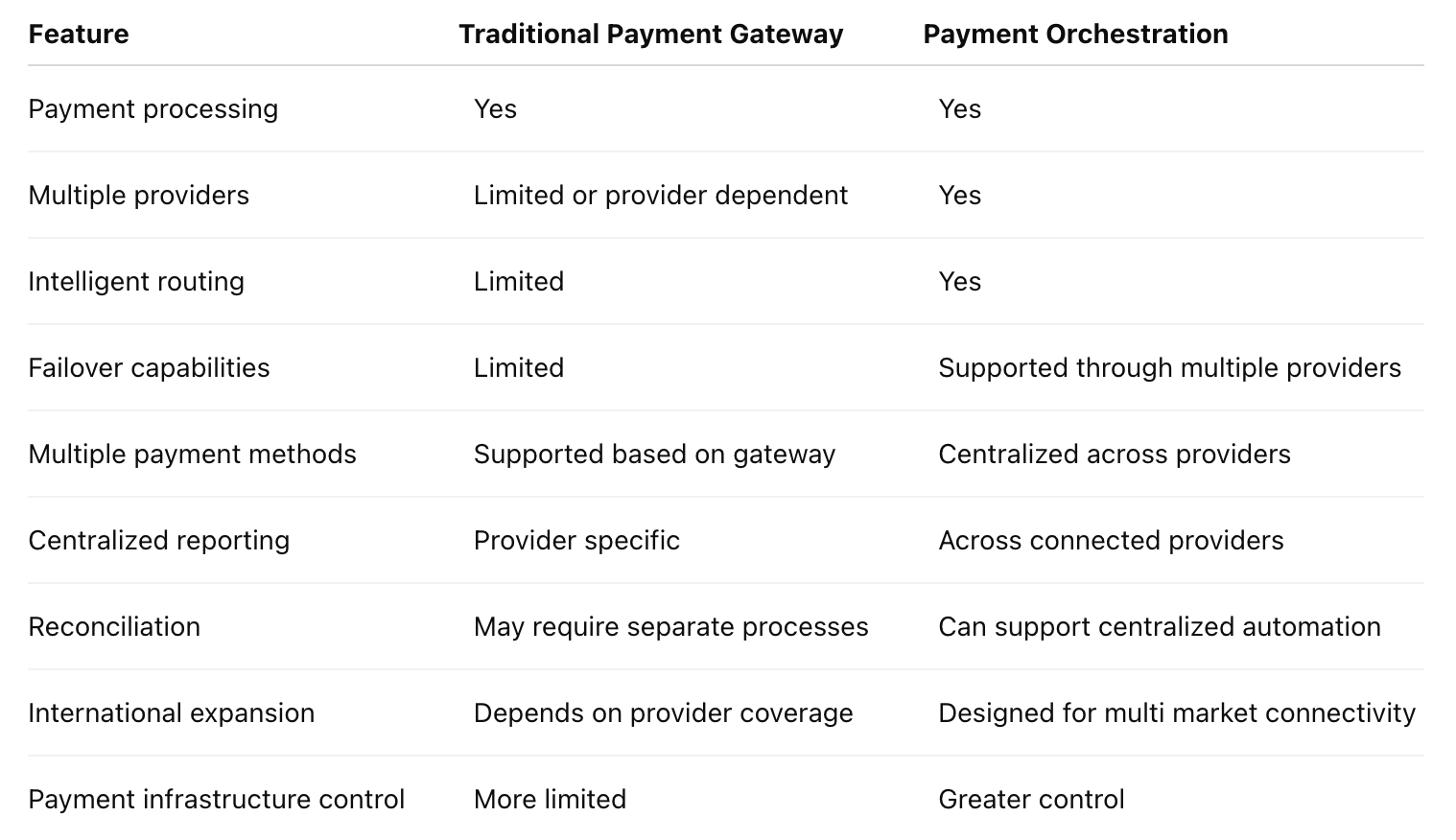
The exact capabilities vary between providers, so businesses should evaluate the platform based on their specific requirements rather than the product category alone.
Does Every Business Need Payment Orchestration?
Not necessarily.
A small business operating in one market with one payment provider and a limited number of payment methods may find a traditional gateway sufficient.
Payment orchestration becomes more relevant when payment complexity increases.
If a business is managing multiple providers, experiencing payment failures, expanding into new markets, adding payment methods, or spending significant time on reconciliation and payment operations, an orchestration platform may provide useful capabilities.
The decision should be based on business requirements, transaction volumes, operational complexity, and future growth plans.
What Should Businesses Look for in a Payment Orchestration Platform?
Businesses evaluating payment orchestration should look beyond the number of integrations available. Consider whether the platform provides:
1. Provider connectivity: Does it connect with the gateways, processors, and acquirers your business needs?
2. Smart routing: Can you create rules for routing transactions?
3. Payment resilience: Does it support appropriate retry and failover strategies?
4. Security: Does it provide strong security and fraud management capabilities?
5. Analytics: Can your teams monitor payment performance from one place?
6. Reconciliation: Can transaction and settlement processes be automated?
7. Scalability: Can the platform support new markets, payment methods, and transaction volumes?
8. Integration: Can your technical team integrate the platform without creating unnecessary complexity?
Final Thoughts
A payment gateway works well for simple payment needs, while payment orchestration offers greater flexibility as your payment setup grows.
Looking to scale your payments? Explore how payment orchestration can simplify and optimize your payment infrastructure.
Frequently Asked Questions
Q1: What is the main difference between a payment gateway and payment orchestration?
A: A payment gateway primarily enables payment processing through its connected infrastructure. Payment orchestration provides a centralized layer for managing multiple gateways, processors, payment methods, and transaction routes.
Q2: Can payment orchestration improve payment success rates?
A: Payment orchestration can support intelligent routing, retries, and alternative processing routes. These capabilities may help businesses manage payment failures, although actual results depend on providers, transaction types, routing rules, and other factors.
Q3: Is payment orchestration suitable for ecommerce businesses?
A: Yes. Ecommerce businesses with high transaction volumes, multiple payment providers, international customers, or several payment methods can benefit from centralized payment management.
Q4: Does payment orchestration replace payment gateways?
A: No. Payment orchestration typically works with payment gateways, processors, and other payment providers. It acts as a centralized layer that connects and manages these payment services.
Q5: Is payment orchestration useful for international businesses?
A: It can be particularly useful for businesses operating across multiple markets because it can provide a centralized way to manage different payment providers, currencies, and local payment methods.
Q6: What are the main benefits of payment orchestration?
A: Key benefits can include multi provider connectivity, intelligent routing, payment resilience, centralized reporting, automated reconciliation, broader payment method coverage, and greater flexibility for international expansion.