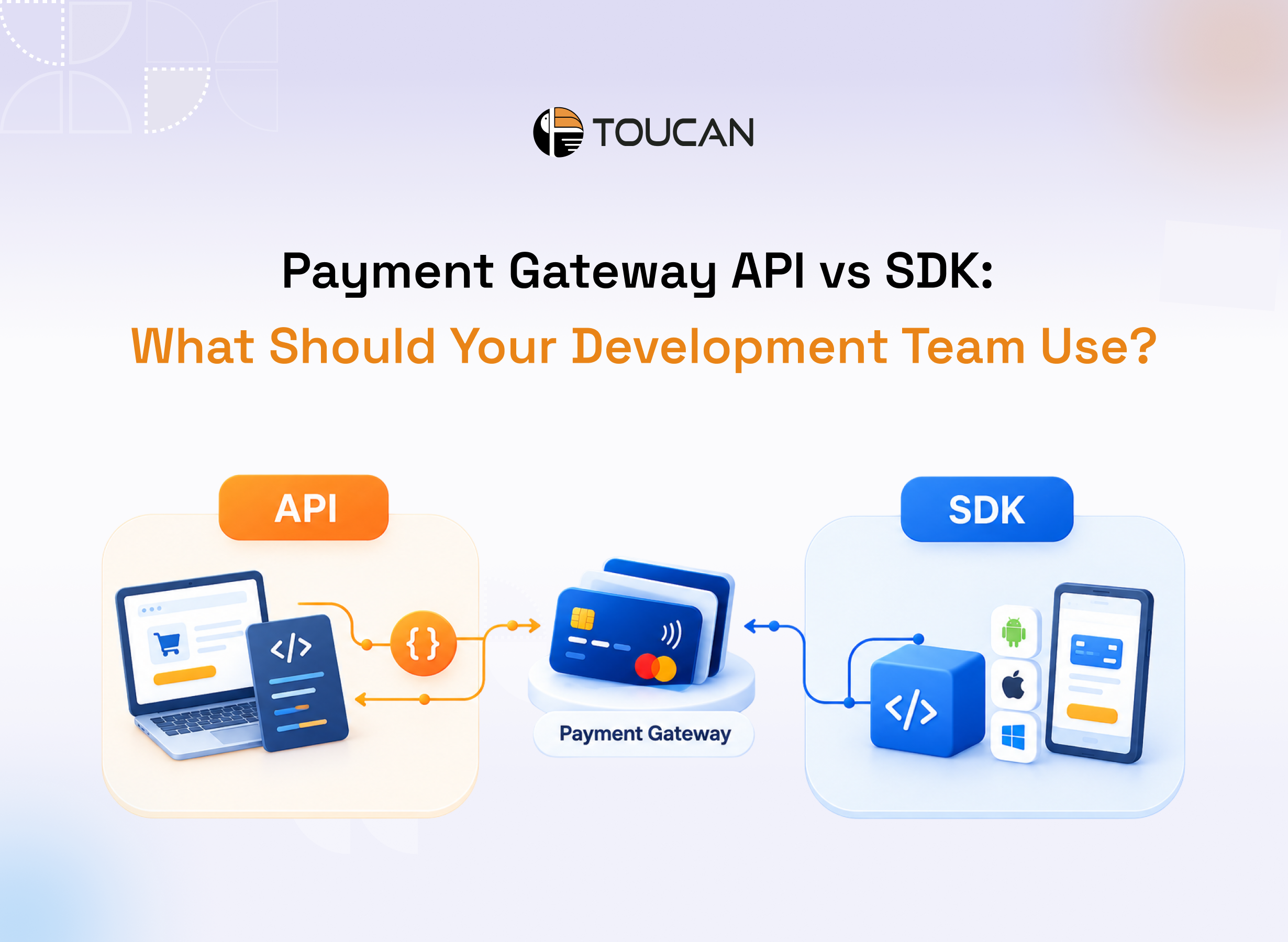
Payment Gateway API vs SDK: What Should Your Development Team Use?
Introduction
Choosing the right payment gateway integration can affect how quickly your business launches, how customers experience checkout, and how easily your team manages payments as the business grows.
Two common options are a payment gateway API and a Software Development Kit (SDK). Both help connect your website or application to payment infrastructure, but they offer different levels of control, flexibility and development effort.
So, which one should your development team choose? The answer depends on your application, checkout requirements, technical resources and long-term payment strategy.
What Is a Payment Gateway API?
A payment gateway API (Application Programming Interface) allows your application to communicate directly with a payment provider. Your development team can use API endpoints to initiate payments, check transaction status, process refunds and manage other payment operations.
For example, an ecommerce business may use a payment API to create an order, initiate checkout and receive transaction updates through webhooks.
APIs are particularly useful when businesses need customised payment workflows, integration with existing systems or greater control over how payment operations work.
However, an API-based integration may require more development work. Your team needs to build the necessary interfaces, handle responses and errors, and implement the required security measures.
What Is a Payment Gateway SDK?
A payment SDK is a collection of software tools, libraries and supporting resources that makes it easier to integrate payment functionality into an application.
Instead of writing every integration component from scratch, developers can use the functions and components provided by the payment provider.
For example, a mobile application can use a payment SDK to display a checkout interface, collect payment information securely and support the payment flow.
SDKs are available for different platforms and programming languages, depending on the provider. They can reduce repetitive coding and simplify integration, although the available features and customisation options vary.
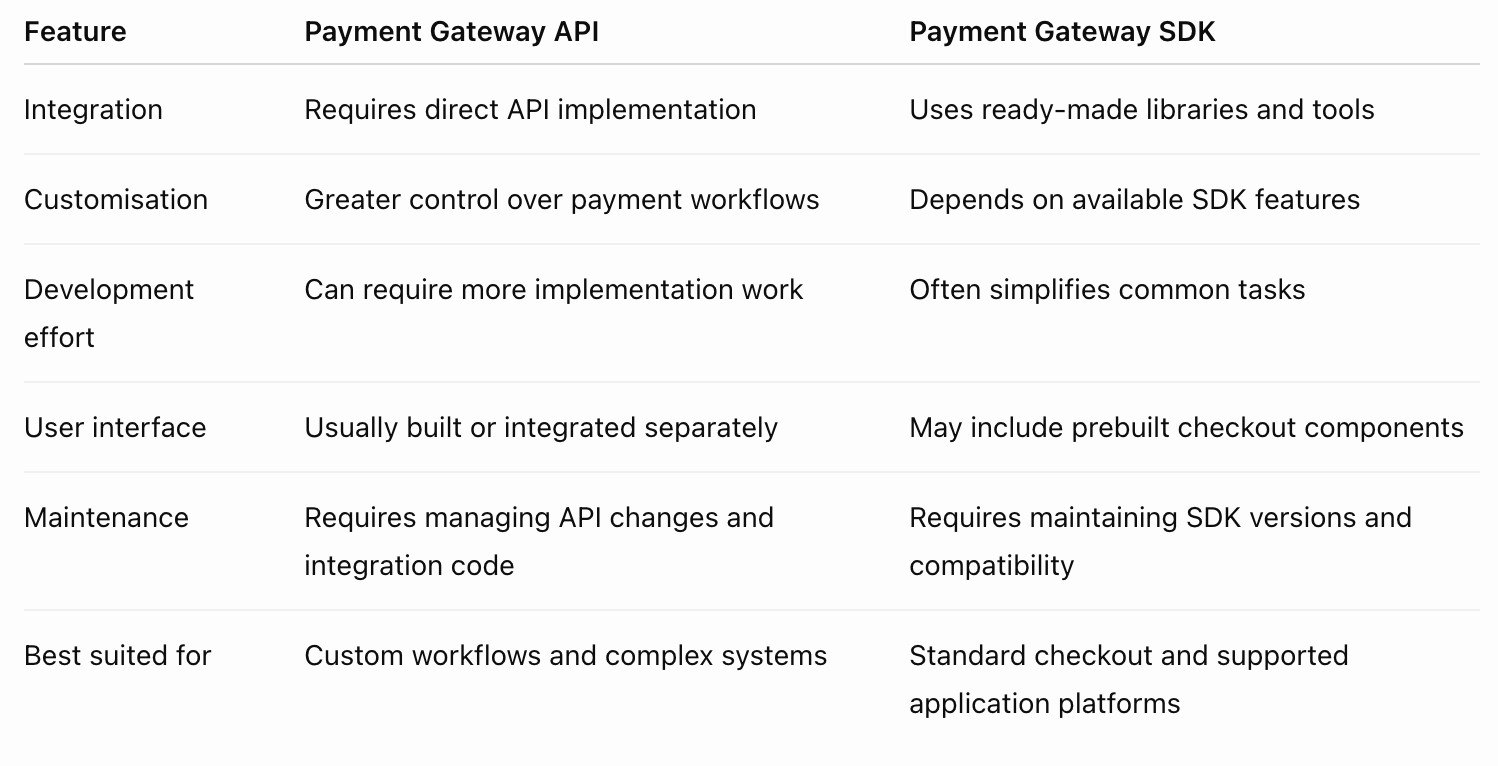
Payment Gateway API vs SDK: Key Differences
One important distinction: an SDK often uses APIs behind the scenes. Choosing an SDK does not necessarily mean avoiding APIs altogether.
When Should You Choose a Payment Gateway API?
An API-first approach can make sense when your payment requirements go beyond a standard checkout experience.
1. You need a customised checkout journey
If your business requires a specific payment flow, custom validation or a specialised user experience, APIs can give your developers greater control over implementation.
2. You are integrating multiple business systems
Businesses connecting payment operations with ERP software, CRM platforms, accounting systems or internal order management tools may benefit from direct API integration.
3. You need greater control over payment operations
If your application requires custom refund workflows, transaction reconciliation, payment status handling or routing logic, APIs provide building blocks for developing those capabilities.
4. Your payment infrastructure is expected to evolve
Businesses expanding into new markets or supporting additional payment methods may need flexible integrations that can accommodate changing requirements.
However, flexibility comes with responsibility. Your team must plan for testing, monitoring, error handling, security and ongoing maintenance.
When Should You Choose a Payment Gateway SDK?
An SDK is often a practical choice when your team wants to simplify implementation without building every component independently.
1. You are launching a mobile application
For Android and iOS applications, platform-specific payment SDKs can provide tools for integrating payment functionality into the app.
2. You want to launch faster
Prebuilt libraries and checkout components can reduce the amount of code your team needs to write and maintain.
3. Your team wants to simplify payment handling
A well-designed SDK may handle certain technical tasks, such as communicating with payment services or managing supported authentication flows. The exact capabilities depend on the provider.
4. Your requirements match the provider’s supported features
If the available checkout interface, payment methods and configuration options meet your needs, an SDK can help avoid unnecessary development effort.
Before choosing one, check platform compatibility, documentation quality, release frequency and the provider’s support for the payment methods you need.
API vs SDK: What About Security?
Security should be part of the decision from the beginning, not something addressed just before launch.
An SDK may provide secure payment collection components and tokenisation features that help prevent sensitive payment details from passing through your application servers. However, this depends on the specific integration and how it is implemented.
With a direct API integration, developers must follow the provider’s security requirements, protect credentials, validate requests and handle sensitive information appropriately.
Neither approach automatically guarantees PCI DSS compliance. Your compliance responsibilities depend on the payment flow, the systems involved and how payment data is collected, transmitted and stored.
Always use the provider’s recommended integration method, keep secret API keys on the server side, verify webhook signatures where supported, and test failure scenarios before going live.
Can We Use a Payment Gateway API and SDK Together?
Yes. In many cases, combining both approaches is the most practical solution.
Consider an ecommerce business that accepts payments through a mobile app and a website. It might use a mobile SDK to simplify the in-app checkout experience while using server-side APIs to create orders, verify payment status and initiate refunds.
This approach lets the development team simplify customer-facing tasks while retaining control over important backend operations.
How to Choose the Right Integration for Your Business
Before making a decision, ask your development team five questions:
1. Application type: Are you building a website, mobile app or both?
2. Customisation: Do you need a standard checkout or a highly customised payment journey?
3. Development resources: Does your team have the time and expertise to build and maintain a custom integration?
4. Security: Does the integration support your security and compliance requirements?
5. Scalability: Can the solution support additional payment methods, markets and transaction volumes as your business grows?
Also review the provider’s documentation, test environment, error handling, webhook support and versioning policy. A straightforward integration today should not become a maintenance challenge tomorrow.
Final Thougths
There is no single winner in the payment gateway API vs SDK comparison. APIs offer flexibility and control, while SDKs can simplify development through ready-made tools and components.
For standard mobile checkout, an SDK may be the better starting point. For complex payment workflows and deeper system integrations, APIs may offer greater flexibility. Many businesses benefit from using both.
The right choice is the one that helps your team deliver a secure, reliable payment experience without creating unnecessary development complexity.
Planning your next payment integration? Explore how a flexible payment infrastructure can help your business simplify payment operations and prepare for growth.
Frequently Asked Questions
Q1. Is a payment gateway API better than an SDK?
A: Not always. APIs provide greater control over integration, while SDKs can simplify common development tasks. The best option depends on your application and business requirements.
Q2. Can I use a payment gateway API without an SDK?
A: Yes. Developers can integrate directly with a provider’s APIs if the required endpoints, authentication methods and payment flows are supported.
Q3. Does a payment SDK improve security?
A: It can help by providing secure payment components and supported tokenisation features. However, security depends on the provider, the implementation and how sensitive data is handled.
Q4. Which is better for mobile payment integration?
A: A mobile SDK is often a convenient starting point because it may include platform-specific libraries and checkout components. API integration may be appropriate when more customisation is required.
Q5. Can an API and SDK work together?
A: Yes. A common approach is to use an SDK for the customer-facing checkout and APIs for backend operations such as order creation, payment verification and refunds.