Complete Guide to Choosing the Best Payment Gateway for Schools, Colleges & EdTech Platforms
Introduction
Collecting student fees should be simple, but for many schools, colleges, and EdTech platforms, it often involves manual reconciliation, payment failures, delayed settlements, and increased administrative effort.
As digital payments become the preferred choice for parents and students, educational institutions need more than just a way to accept payments. They need a payment solution that streamlines fee collection, integrates with existing systems, and provides a seamless payment experience across every touchpoint.
Whether you’re selecting a payment gateway for the first time or looking to switch providers, choosing the right solution can improve operational efficiency, reduce payment-related issues, and enhance the overall payment experience.
This guide explains what educational institutions should look for in a payment gateway, the common challenges they face, and the key factors to consider before making a decision.
What Is a Payment Gateway for Educational Institutions?
A payment gateway for educational institutions enables schools, colleges, universities, coaching institutes, and EdTech platforms to securely collect online payments from parents and students.
Beyond processing payments, modern solutions support multiple payment methods, automate reconciliation, simplify refunds, and integrate with ERP, SIS, and LMS platforms. This helps institutions reduce administrative effort while providing a better payment experience.
Why Educational Institutions Need a Specialized Payment Gateway
Unlike traditional retail businesses, educational institutions manage recurring fee cycles, multiple payment categories, and thousands of student transactions throughout the academic year. Managing these payments manually can increase administrative effort, delay collections, and make financial reporting more complex.
A modern payment gateway simplifies fee collection while giving finance teams greater visibility into payments, settlements, and reconciliation.
For educational institutions, a reliable payment gateway can help:
1. Simplify online fee collection
2. Improve payment success rates
3. Reduce manual reconciliation
4. Support multiple payment methods
5. Deliver a better payment experience for parents and students
Rather than treating payments as an administrative task, institutions can use technology to create a smoother and more efficient fee collection process.
Common Payment Challenges Faced by Schools, Colleges & EdTech Platforms
Despite the growth of digital payments, many educational institutions still face operational challenges that affect both finance teams and students.
1. Manual Reconciliation: Many institutions spend hours matching payments with student records, especially when payments come from different channels. Manual reconciliation increases workload and leaves room for errors.
2. Failed Transactions: Payment failures during admission periods or fee deadlines can frustrate parents and delay collections. A poor payment experience may also increase support requests to administrative staff.
3. Limited Payment Options: Parents have different payment preferences. Some prefer UPI, while others rely on credit cards, debit cards, net banking, or digital wallets. Offering limited payment methods can reduce payment completion rates.
4. Managing Refunds: Refunds due to admission cancellations, duplicate payments, or course withdrawals should be handled efficiently. Delays often result in unnecessary follow-ups and dissatisfaction.
5. Lack of Integration: Disconnected payment systems often require finance teams to manually update ERP, Student Information Systems (SIS), Learning Management Systems (LMS), or accounting software. This slows down operations and increases administrative effort.
6. Limited Visibility into Settlements: Tracking when payments are settled and reconciling them with student records can be challenging, especially for institutions processing large transaction volumes. Limited settlement visibility often affects cash flow planning and financial reporting.
Recognizing these challenges is the first step toward selecting a payment gateway that aligns with your institution’s operational needs.
How to Evaluate a Payment Gateway for Educational Institutions
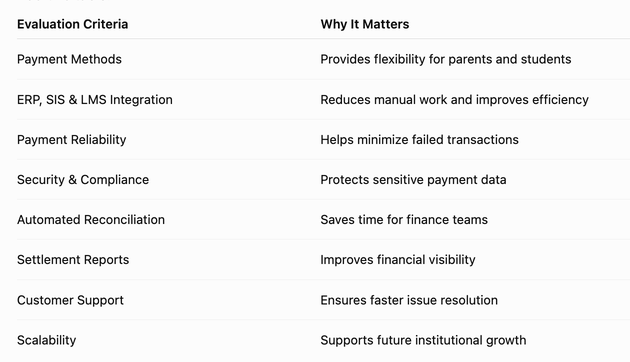
With many payment gateways available in the market, comparing providers solely based on transaction fees can be misleading. Instead, institutions should evaluate how well a payment gateway supports their long-term operational and student experience goals.
1. Ease of Integration
The payment gateway should integrate smoothly with your existing ERP, Student Information System, Learning Management System, or accounting platform. A well-integrated solution reduces manual work and ensures payment information is updated automatically.
2. Reliable Payment Experience
Parents expect payments to be completed quickly and without technical issues. A gateway with consistent performance and minimal downtime helps improve payment completion rates, especially during peak admission and fee collection periods.
3. Flexible Payment Options
Different families prefer different payment methods. Supporting UPI, debit cards, credit cards, net banking, wallets, and EMI options provides greater convenience and reduces payment friction.
4. Faster Reconciliation
Finance teams should be able to easily track collections, settlements, and payment status through centralized reporting. Automated reconciliation saves time and improves financial accuracy.
5. Security and Compliance
Educational institutions handle sensitive financial information. Choose a provider that follows industry security standards, uses encryption, and complies with relevant payment regulations to help protect payment data.
6. Scalability
Your payment requirements today may be very different a few years from now. Whether you’re expanding campuses, increasing student enrollment, or launching online programs, your payment infrastructure should be able to grow with your institution.
7. Reporting and Settlement Visibility
Finance teams should have access to real-time reports, settlement summaries, and payment insights that make reconciliation easier and support informed financial decisions.
Why Toucan Payments for Educational Institutions
Educational institutions need a payment partner that not only enables secure digital payments but also simplifies fee collection, reduces operational effort, and supports long-term growth.
Toucan Payments is designed to help schools, colleges, universities, coaching institutes, and EdTech platforms streamline digital fee collection with a secure and scalable payment infrastructure.
With Toucan, institutions can benefit from:
1. Multiple digital payment options, including UPI, cards, net banking, and wallets
2. Secure payment processing with industry-standard compliance
3. Easy integration with ERP, Student Information Systems, and Learning Management Systems
4. Automated reconciliation and real-time reporting
5. Reliable payment processing during high-volume admission and fee collection periods
6. Dedicated implementation and support teams
Whether you’re modernizing fee collection or launching a new digital learning platform, Toucan provides the flexibility to support institutions of different sizes and business models.
Conclusion
The right payment gateway does more than process transactions. It helps educational institutions simplify fee collection, reduce administrative effort, improve payment experiences, and support long-term digital transformation.
If you’re evaluating a payment solution for your school, college, university, or EdTech platform, Toucan Payments provides the payment infrastructure to help you deliver secure, reliable, and scalable digital payment experiences.
Frequently Asked Questions
Q1: Which payment gateway is best for schools and colleges?
A: The best payment gateway depends on your institution’s requirements. Look for a solution that offers secure payment processing, multiple payment methods, easy integration with existing systems, reliable performance, and automated reconciliation.
Q2: Can schools accept UPI payments?
A: Yes. Most modern payment gateways support UPI along with cards, net banking, and digital wallets, giving parents the flexibility to pay using their preferred payment method.
Q3: Why is payment gateway integration important for educational institutions?
A: Integration with ERP, SIS, or LMS systems helps automate payment tracking, reduce manual data entry, improve reconciliation, and simplify administrative processes.
Q4: What should educational institutions consider before selecting a payment gateway?
A: Evaluate payment methods, security, system integration, reconciliation capabilities, settlement timelines, scalability, and customer support rather than focusing only on transaction charges.