Payment orchestration vs. payment gateway: key differences explained
Scaling an online business in India brings a hidden challenge: payment failures. When your transaction volume grows, relying on a single payment provider often leads to checkout friction, downtime, and lost revenue. This is where the debate between using a traditional payment gateway and upgrading to a payment orchestration platform (POP) begins.
While both facilitate digital transactions, they serve entirely different functions in your payment stack. Here is the definitive guide to understanding payment orchestration vs. payment gateways, and why modern businesses are upgrading their infrastructure with platforms like ToucanPay.
What is a Payment Gateway?
A payment gateway is the digital equivalent of a physical point-of-sale (POS) terminal. It securely captures the customer’s payment details, encrypts them, and transmits them to the payment processor or acquiring bank to authorize the transaction.
They hold the direct acquiring licenses, maintain relationships with banks (like HDFC or ICICI), and handle the heavy regulatory burden of moving funds and settling them into your merchant account. If you are just starting out, integrating a single payment gateway (like ToucanPay PG, Razorpay, PayU, or Cashfree) is usually the quickest way to accept UPI, cards, and net banking.
The limitations of relying on a single gateway:
➤ Single point of failure: If the gateway goes down, your entire checkout goes down.
➤ Limited geographical/method coverage: No single gateway supports every alternative payment method globally or even regionally with perfect success rates.
➤ Vendor lock-in: You are at the mercy of one provider’s pricing, downtime, and policy changes.
What is Payment Orchestration?
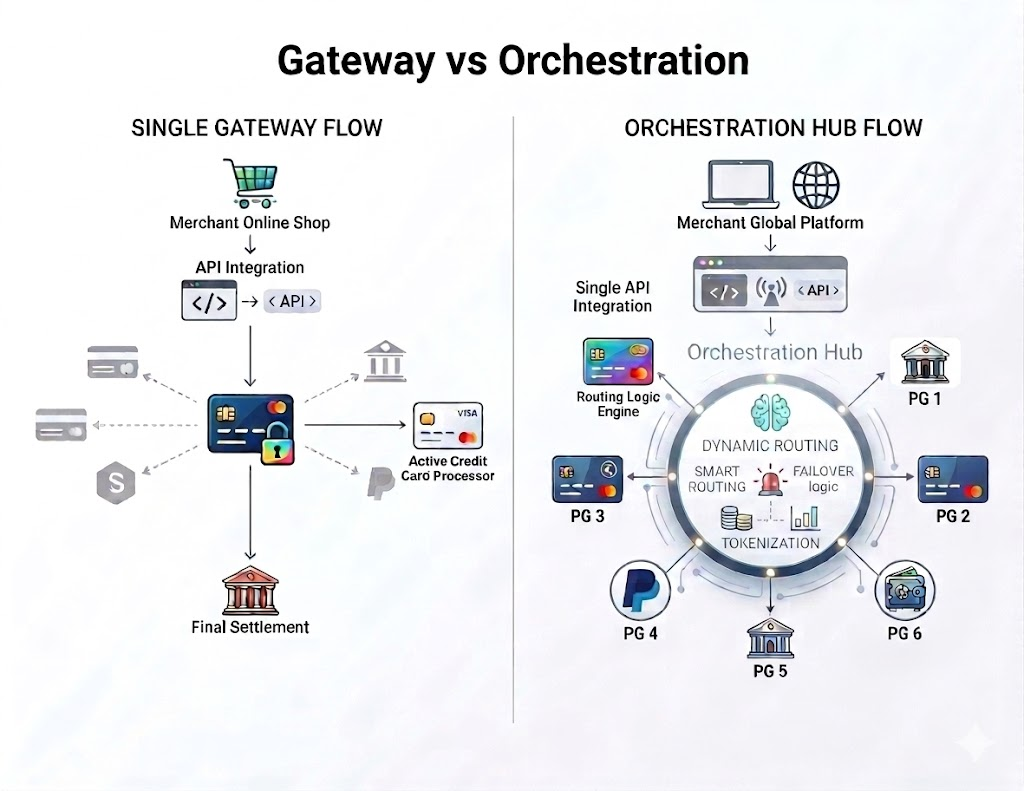
Payment orchestration is a software layer that sits between your website/app and multiple payment gateways, processors, and acquirers. Instead of processing the payment itself, a Payment Orchestration Platform directs the payment traffic.
If gateways are the delivery trucks in a logistics network doing the heavy lifting, orchestration is the smart dispatch center. It looks at all available trucks in real-time, checks the traffic (bank downtime), and decides which truck should take which package to guarantee it arrives the fastest and cheapest.
Core features of a POP include:
➤ Smart Routing: Automatically routing transactions to the best-performing gateway based on criteria like card type, bank, location, or transaction amount.
➤ Dynamic Fallback: If Gateway ‘A’ fails due to downtime, the orchestration engine instantly retries the payment through Gateway ‘B’ before the customer even notices.
➤ Unified Vaulting: A universal, PCI-compliant card vault that tokenizes customer data independently of any single gateway, allowing you to switch providers without losing saved cards.
The Key Differences: Orchestration vs. Gateways
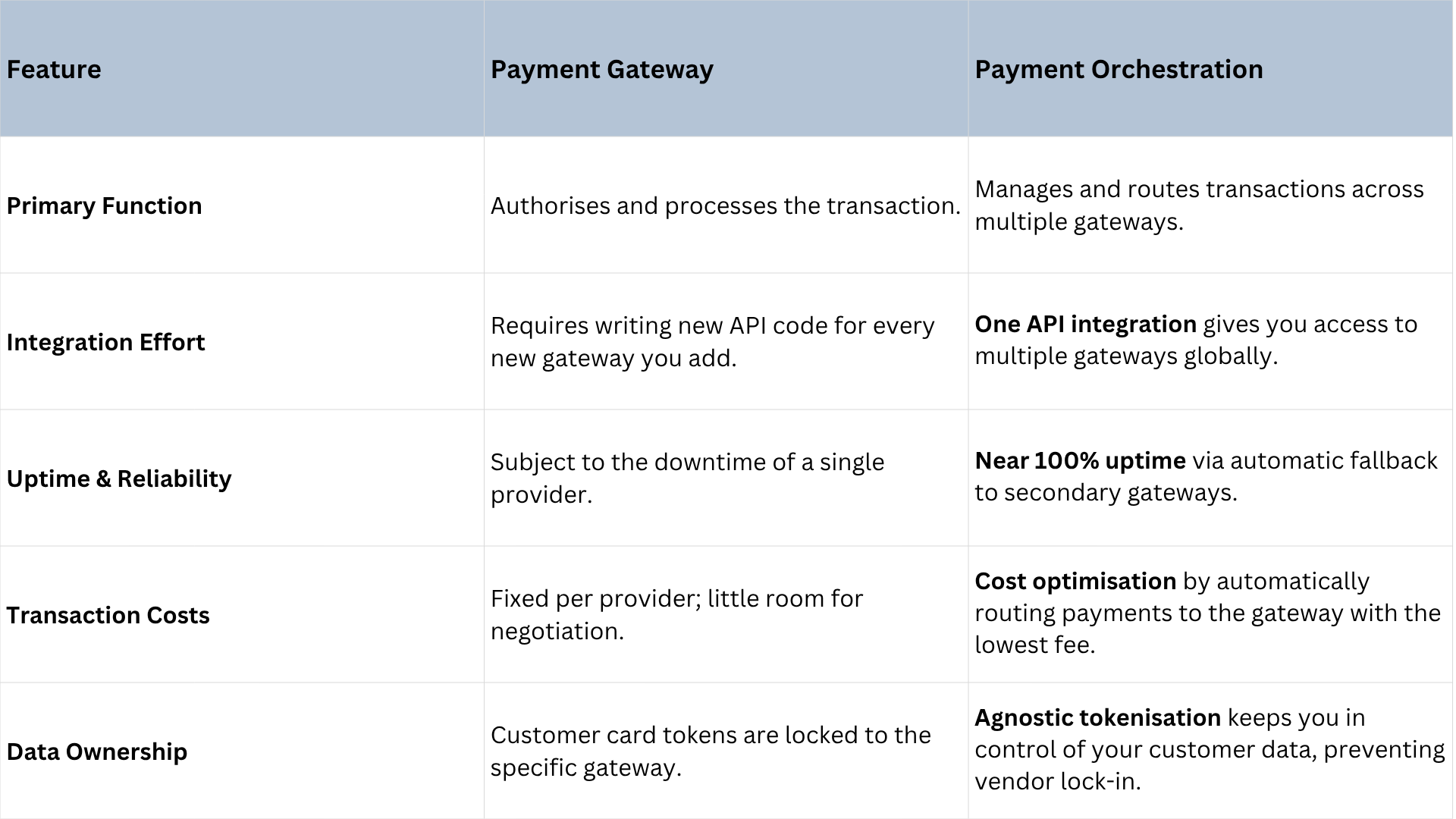
To understand which solution fits your business stage, here is a direct comparison of their capabilities.
The Big Misconception: Why Scaling Businesses Need Both
There is a common misconception that upgrading to payment orchestration means ditching your payment gateways. You cannot have payment orchestration without payment gateways. Orchestration doesn’t process the money; it just tells the money where to go.
When you are small, a single gateway is enough. But as you scale, adding a second or third gateway without orchestration creates a fragmented, high-maintenance mess for your engineering and finance teams. You need payment gateways to legally and securely process the cash, and you need payment orchestration to manage those gateways. Layering them together solves the specific growing pains of a scaling business:
1. Maximizing Transaction Success Rates (SR)
In India, payment failure rates can range from 15% to 30% depending on bank downtimes and network congestion. Payment orchestration platforms like ToucanPay use AI-driven smart routing to bypass degraded bank nodes. If bank ‘A’ net banking is failing on your primary gateway, ToucanPay instantly routes it to your secondary gateway, saving the sale seamlessly
2. Effortless Multi-Gateway Scaling
Scaling internationally or adding new payment methods used to mean months of developer time reading API documentation. With an orchestration platform, you integrate once. The gateways maintain the specific API connections to local wallets and BNPL providers but adding them to your checkout becomes a simple toggle in your orchestration dashboard.
3. Cost Arbitrage at Scale
Different gateways charge different MDRs (Merchant Discount Rates) for different payment methods. Orchestration routes RuPay transactions to the cheapest RuPay processor, and premium credit cards to the best credit card processor, saving fractions of a percent that add up to massive revenue retention on millions of transactions.
4. Simplified Reconciliation
Using multiple gateways without orchestration creates an accounting nightmare. Finance teams have to download reports from three different dashboards and manually match them. Orchestration centralises all transaction data, refunds, and settlements into a single, unified dashboard, no matter which gateway processed the actual funds.
The Verdict
A payment gateway is a necessary tool for processing money. Payment orchestration is the strategy for optimising it.
If your business processes low volumes, a single payment gateway is sufficient. However, if your transaction volume is growing, you are losing revenue to failed payments, or you are expanding to new markets, relying on a single provider is a critical business risk.
By integrating a payment orchestration platform like Superstream from ToucanPay to manage your underlying gateways, you take back control of your payment stack, reducing costs, eliminating downtime, and giving your customers the seamless checkout experience they expect.
Frequently Asked Questions:
Q1: What is the main difference between payment orchestration and a payment gateway?
A: Payment gateways securely transmit payment data from checkout to processors, handling one primary path. Orchestration layers above multiple gateways/PSPs, adding smart routing, failover, and optimization—like Flipkart directing UPI traffic across ToucanPay and PayU during peak sales.
Q2: When should a business switch from a gateway to orchestration?
A: Switch when facing high decline rates (>2%), cross-border expansion, or UPI congestion issues.
Q3: How does orchestration improve authorisation rates?
A3: It dynamically routes transactions to the best PSP based on BIN, geography, or real-time performance.
Q4: What are typical costs of orchestration platforms?
A: Usually 0.5-2% per transaction atop gateway fees, but ROI comes fast via 3-10% auth gains and cost optimisation.
Q5: How long does orchestration integration take?
A: 2-6 weeks via single API, versus months for multi-gateway setups. Toucan Payments’ Superstream connects Razorpay/PayU instantly, letting Indian brands expand across border without rebuilding.