How Long Should Merchant Onboarding Take? Benchmarks vs Reality in India
Introduction
You’ve chosen a payment gateway, submitted your documents, and expected to start accepting payments within a day. Instead, you’re asked for additional documents, website updates, or business verification, and the process takes several days.
If this sounds familiar, you’re not alone.
Merchant onboarding is one of the most important steps before a business can start accepting online payments. While many payment providers advertise quick sign-ups, the reality is that activation timelines depend on several factors, including regulatory compliance, business verification, and the completeness of your documentation.
So, how long should merchant onboarding actually take?
In this guide, we’ll break down the typical onboarding timeline in India, explain why delays happen, and share practical tips to help your business get approved faster.
What Is Merchant Onboarding?
Merchant onboarding is the process through which a payment gateway or payment aggregator verifies a business before allowing it to accept digital payments.
It’s much more than creating an account. Payment providers must ensure that every merchant meets regulatory requirements, follows compliance standards, and poses minimal financial or fraud risk before transactions can go live.
A typical merchant onboarding process includes:
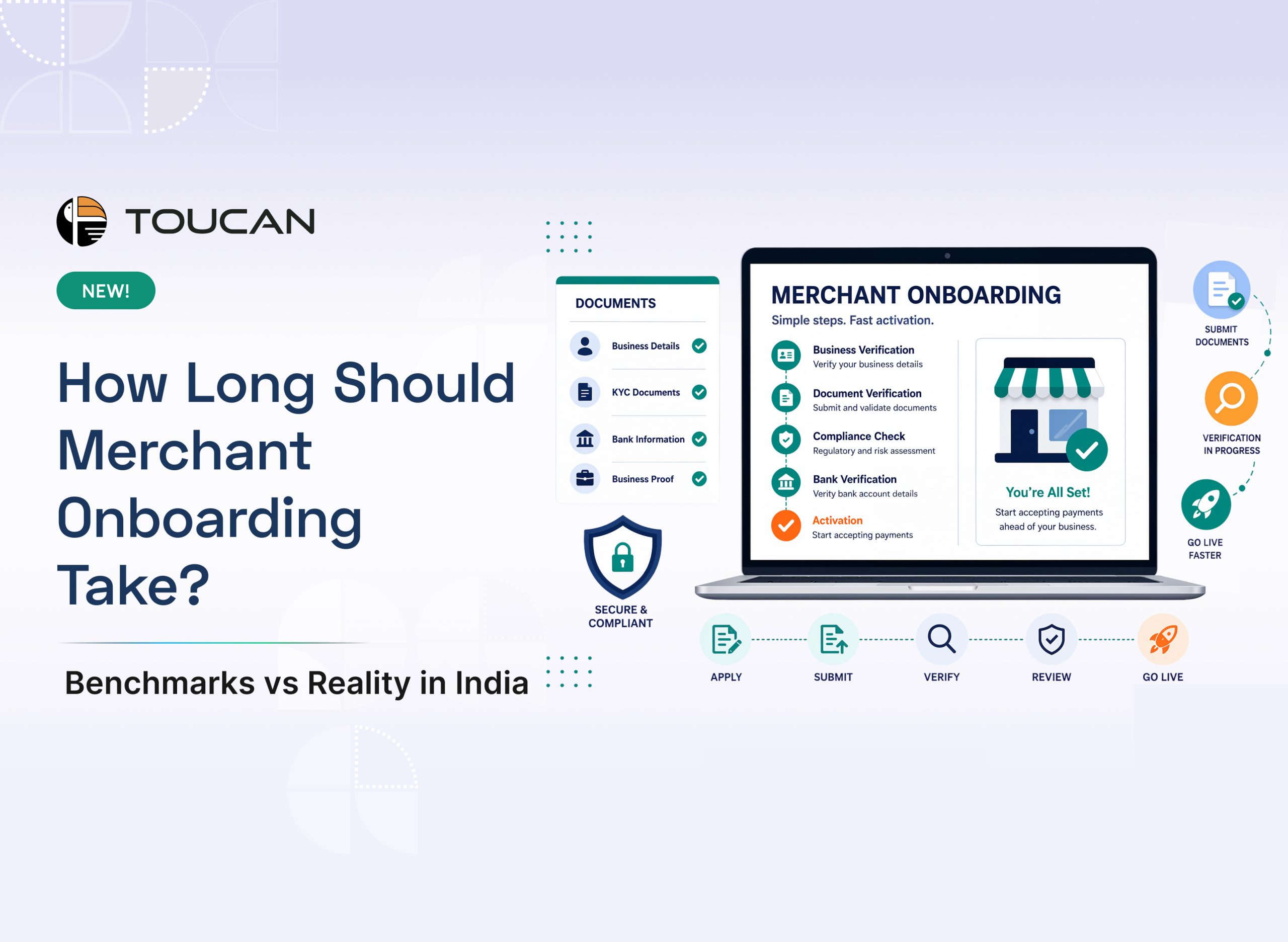
1. Business registration and account creation
2. Identity and business verification (KYC/KYB)
3. Document submission and validation
4. Risk and compliance assessment
5. Bank account verification
6. Payment gateway activation and technical integration
Once these checks are completed successfully, merchants receive approval and can begin accepting payments through their website, app, or other digital channels.
Although the process may seem lengthy, these verification steps help create a safer payments ecosystem for both businesses and customers.
Why Does Merchant Onboarding Sometimes Take Longer?
Many businesses assume merchant onboarding should be completed instantly. However, payment providers must balance speed with security, compliance, and risk management.
Here are the most common reasons onboarding takes longer than expected.
1. Incomplete or Incorrect Documentation
Missing documents, mismatched business details, expired identification, or incorrect bank account information are among the biggest reasons applications are delayed. Even a small discrepancy between your PAN, GST registration, and bank account can trigger additional verification.
2. Business Risk Assessment
Not all businesses carry the same level of risk. Industries such as travel, edtech, ecommerce, financial services, subscriptions, healthcare, or cross-border commerce often require enhanced due diligence before approval.
3. Website Compliance Issues
Before activating a merchant, payment providers typically review the business website or application. Missing pages such as Privacy Policy, Refund Policy, Terms & Conditions, Contact Information, or unclear product descriptions may result in additional review requests.
4. Regulatory and Compliance Checks
Payment providers are required to conduct KYC and anti-money laundering (AML) checks to comply with regulatory requirements. These checks protect the payment ecosystem from fraud, financial crime, and unauthorised transactions.
5. Delayed Responses from Merchants
Sometimes the delay isn’t caused by the payment provider. Additional document requests or clarification emails often remain unanswered for days, extending the overall onboarding timeline.
Benchmarks vs Reality
Many businesses expect to start accepting payments immediately after submitting their application. In reality, merchant onboarding involves several verification stages that can affect activation timelines.
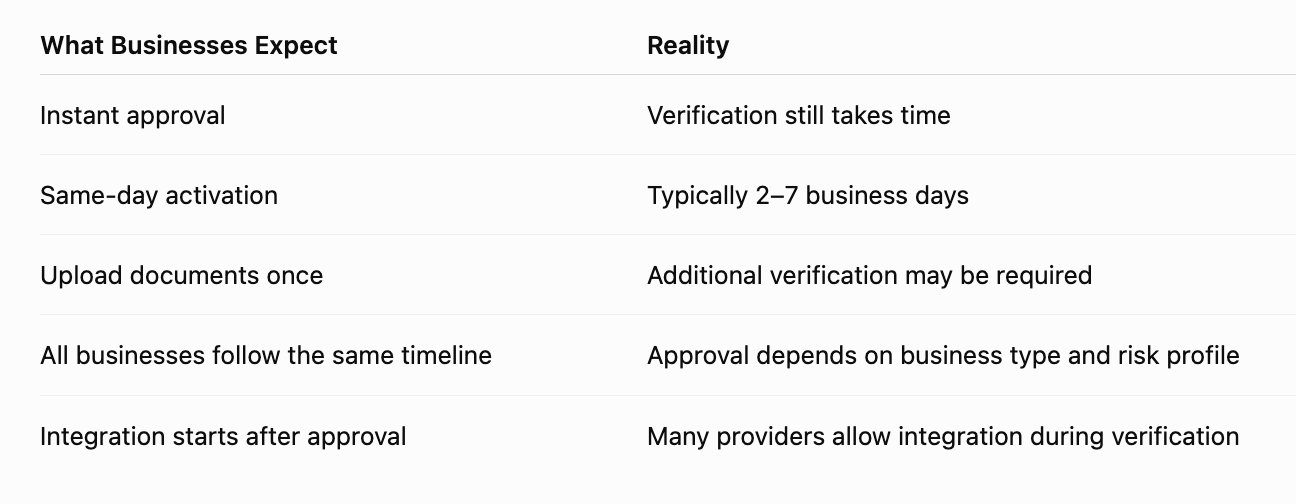
For businesses with complete documentation and straightforward business models, onboarding can be completed relatively quickly. However, companies operating in regulated or higher-risk industries should expect additional compliance reviews before activation.
The key takeaway is simple: fast onboarding isn’t just about the provider—it’s also about how prepared your business is.
What Actually Determines Your Approval Time?
No two businesses are exactly alike, which means onboarding timelines can vary significantly. Several factors influence how quickly a payment provider can verify and approve your application.
1.Business Structure: Whether you’re a sole proprietor, partnership, LLP, or private limited company determines the type of documentation required during verification.
2.Industry Category: Certain industries undergo enhanced risk assessments due to regulatory requirements or historical fraud exposure.
3.Quality of Submitted Documents: Clear, accurate, and up-to-date documents reduce manual verification and minimise follow-up requests.
4.Website Readiness: A professional website with complete business information, legal policies, and clearly described products or services helps speed up compliance reviews.
5.Expected Transaction Volume: Businesses processing higher payment volumes or handling international transactions may require additional risk assessments before activation.
6.Technical Readiness: Completing payment gateway integration, testing APIs, and preparing your checkout flow while verification is underway can help you go live sooner once approval is granted.
Ultimately, merchant onboarding isn’t measured by how quickly an application is submitted—it’s measured by how quickly it can be verified with confidence.
How Toucan Payments Simplifies Merchant Onboarding
At Toucan Payments, we believe merchant onboarding should be fast, transparent, and built around your business—not unnecessary paperwork.
Our onboarding process combines digital verification, dedicated support, and secure compliance workflows to help businesses move from application to activation as efficiently as possible.
With Toucan Payments, merchants benefit from:
• A guided digital onboarding experience with clear document requirements
• Secure KYC and compliance verification aligned with regulatory standards
• Dedicated onboarding assistance throughout the approval process
• Quick API integration and developer-friendly documentation
• Scalable payment infrastructure designed for startups, SMEs, and enterprise businesses
While every application must complete the required verification process, our goal is to minimise avoidable delays so you can start accepting payments with confidence.
Conclusion
Merchant onboarding doesn’t have to be a lengthy or frustrating process. With the right documentation, a compliant business setup, and a reliable payment partner, most businesses can get approved quickly and start accepting payments with confidence.
Ready to simplify your merchant onboarding? Connect with Toucan Payments to experience a faster, transparent, and hassle-free onboarding process tailored to your business needs.
Frequently Asked Questions
Q1: How long does merchant onboarding usually take in India?
A: For most standard businesses with complete documentation, merchant onboarding typically takes 2–7 business days. More complex businesses may require additional verification before approval.
Q2: Why is my payment gateway approval delayed?
A: The most common reasons include incomplete documentation, website compliance issues, additional KYC verification, high-risk business categories, or delayed responses to compliance requests.
Q3: Can merchant onboarding be completed in one day?
A: Some low-risk businesses with complete documentation may receive faster approvals. However, regulatory verification and compliance checks mean same-day activation isn’t always possible.
Q4: What documents are required for merchant onboarding?
A: Requirements vary by business type, but commonly include business registration documents, PAN, GST certificate (if applicable), bank account details, authorised signatory identification, and website information.
Q5: Does every business have the same onboarding timeline?
A: No. Approval timelines depend on your business structure, industry, transaction profile, documentation quality, and regulatory requirements.
Q6: How can businesses speed up merchant onboarding?
A: Prepare complete and accurate documents, ensure your website includes all required legal pages, keep business information consistent across all records, and respond promptly to any verification requests from your payment provider.