Payment gateway vs payment aggregator vs payment orchestration: what’s the difference?
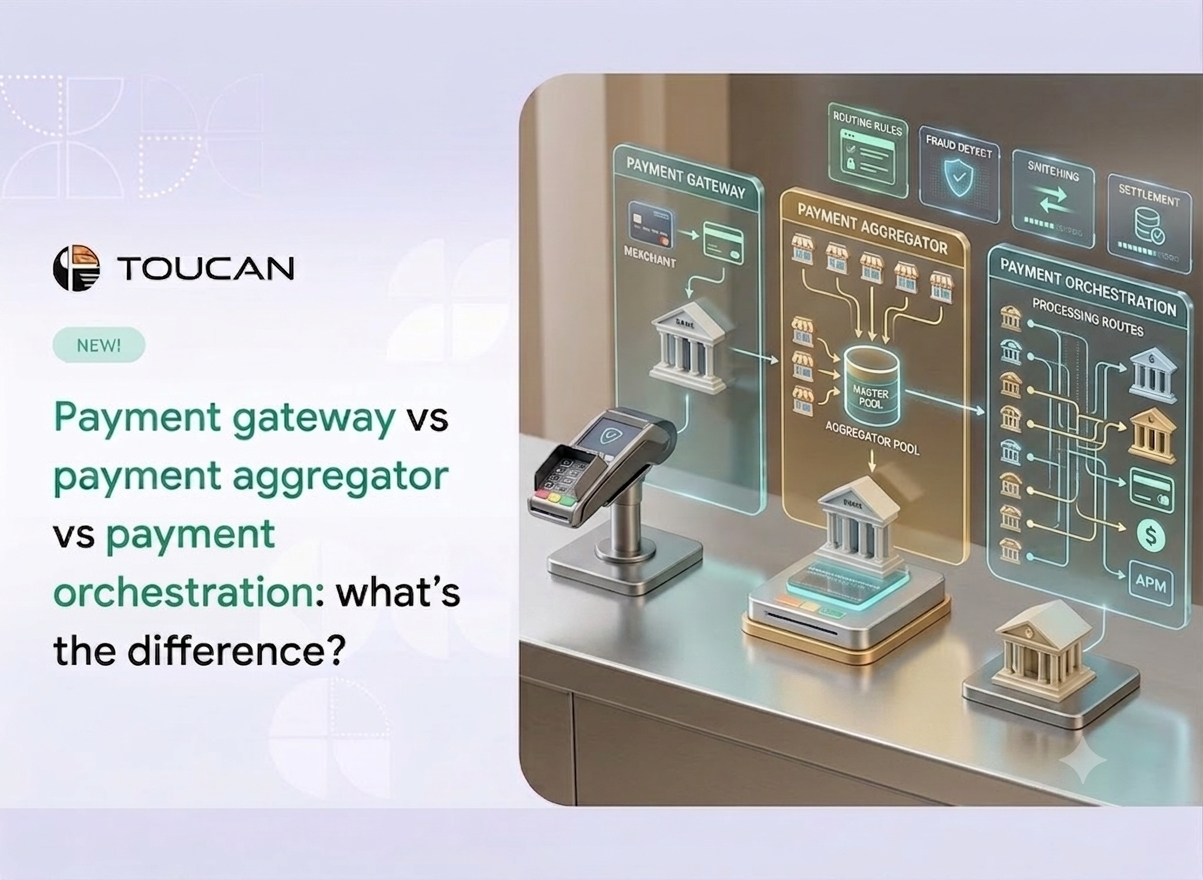
Three terms. Used interchangeably by most merchants. They mean completely different things — and picking the wrong layer for your stage of growth quietly erodes revenue.
Why getting this wrong costs you more than clarity would
Most businesses pick a payment solution based on what someone recommended, what integrated fastest, or what the first sales call sold them. The result is a setup that works at low volume and quietly breaks as you scale — wrong tool for the job, wrong cost structure for your volume, wrong level of control for your complexity.
The three layers below each solve a different problem. Choosing between them is not a technical decision. It is a business one.
What is a payment aggregator?
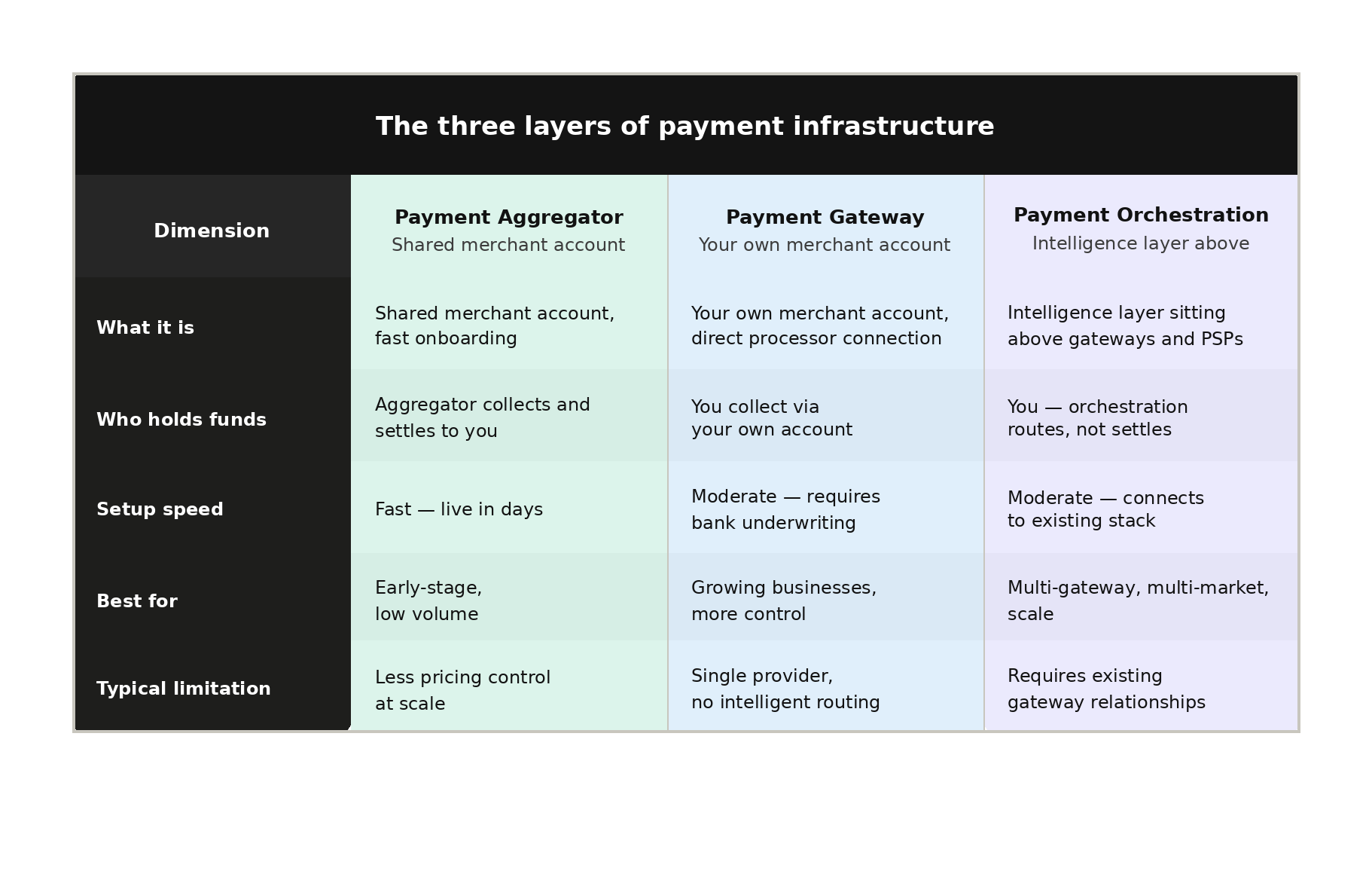
A payment aggregator pools multiple merchants under a single master merchant account. Instead of applying for your own merchant account with an acquiring bank — which involves underwriting, documentation, and weeks of approval — you onboard under the aggregator’s account and start accepting payments within days.
How payment aggregators work
Razorpay, PayU, and Cashfree operate as payment aggregators in India. Stripe plays the same role globally. When a customer pays you, the money lands in the aggregator’s nodal account (a regulated pooled account held on behalf of multiple merchants) first. After deducting fees, the aggregator settles to your bank — typically on a T+1, T+2 cycle.
What is a payment gateway?
A payment gateway is the technology layer that securely transmits transaction data between your checkout, the payment processor, and the customer’s bank. It encrypts and forwards payment information, receives authorisation, and communicates the result back to your system.
How payment gateways work
Unlike an aggregator, a standalone gateway requires your own merchant account with an acquiring bank. This involves underwriting — the bank assesses your business before approving you — but gives you direct control over pricing, settlement timelines, and your acquiring relationship. At scale, you can negotiate interchange rates and access better settlement terms.
The limitations of a standalone gateway
A gateway is a single pipe, well built — but still a single pipe. There are three things a gateway does not do:
✓ It does not route transactions intelligently across multiple processors
✓ It does not automatically retry failed transactions through an alternate provider
✓ It does not unify reporting across multiple payment sources
When your PSP (Payment Service Provider — the company running your gateway) has an outage or a decline spike, you have no automatic fallback. Every failed transaction is potential revenue lost silently.
What is payment orchestration?
Payment orchestration is a software layer that sits above your gateways and PSPs. It does not replace them — it manages them. A single API connects to multiple providers, and the orchestration layer decides in real time which provider handles each transaction, based on success rate, cost, geography, and transaction type.
How payment orchestration works
The hierarchy is worth understanding clearly: the aggregator handles the acquiring relationship. The gateway handles secure data transmission. Orchestration handles the decision-making across all of it — in milliseconds, before the customer sees any result.
Key features of a payment orchestration layer
👉 Smart routing directs each transaction to the provider with the highest expected approval rate for that card type, issuing bank, and amount — reducing failures without the customer ever seeing a retry.
👉 Automatic failover detects when a PSP is down and reroutes live transactions in milliseconds, rather than dropping the sale.
👉 Unified reconciliation normalises settlement data from every connected provider into one report — eliminating the multi-dashboard, multi-format problem that worsens with every gateway you add.
👉 PCI scope reduction centralises sensitive payment data in one vault rather than spreading it across every connected gateway, simplifying your compliance posture.
👉 Checkout abandonment recovery through intelligent retry logic routes soft declines through an alternate provider — recovering revenue that would otherwise vanish without the customer taking any action.
Which one does your business actually need?
The right answer depends on where you are today, not where you plan to be.
📌 Under ₹30L/month
Start with an aggregator
Fast setup, simple integration, predictable costs. Right for early-stage businesses that need to go live quickly.
📌 ₹50L+ per month
Add a dedicated gateway
Your own merchant account, better pricing control, direct acquiring relationship. Accept more setup for more commercial leverage.
📌 Multi-gateway / multi-market
Add orchestration
Multiple gateways, cross-border payments, high volume, or recurring payment failures. Orchestration is the missing layer that makes your stack work properly.
The bottom line
Aggregators get you started. Gateways give you control. Orchestration makes the whole stack work together.
Most payment infrastructure problems are not caused by choosing the wrong provider. They are caused by staying on the right-for-then solution well past the point where it stopped fitting.
At ToucanPay, we build the orchestration layer that connects your existing gateways, routes intelligently, and unifies your reporting — without rebuilding your payment stack from scratch. If you are not sure which layer your business actually needs right now, we are happy to walk through it.
Talk to us about your payment infrastructure →
Frequently Asked Questions
Q1: Is a payment aggregator the same as a payment gateway?
A: No — they are different layers of the payment stack. An aggregator holds funds on your behalf under its own merchant account and settles to you. A gateway is purely a technology layer that transmits transaction data securely between parties. Some providers, like Razorpay, function as both — offering gateway technology built on top of an aggregator model.
Q2: Does payment orchestration replace my existing gateway?
A: No — orchestration sits above your existing gateways and PSPs. You keep your current provider relationships. The orchestration layer connects to all of them through a single API and manages routing, failover, and reporting across all of them simultaneously.
Q3: At what volume does an aggregator stop making sense?
A: There is no hard threshold, but the economics typically shift above ₹50 lakh monthly volume. At that point, the flat-rate fee structure of most aggregators starts to cost more than a direct acquiring relationship would — and the lack of routing flexibility starts to affect success rates in ways that compound at scale.
Q4: Can I use orchestration without multiple gateways?
A: Yes — many businesses start with orchestration connected to a single provider and add gateways over time. The value of the normalisation and reporting layer is immediate even with one PSP. The routing and failover benefits compound as you connect more.