Complete Guide to Payment Gateways for Ecommerce Businesses in India
Introduction
For an ecommerce business, getting a customer to the checkout page is only half the job. The real challenge is helping them complete the payment successfully.
A slow checkout, limited payment options, payment failure, or lack of trust can quickly turn a ready-to-buy customer into an abandoned cart. This is why choosing the right payment gateway for an ecommerce business is an important part of building a reliable online store.
A payment gateway connects your ecommerce website or app with banks, card networks, UPI, and other payment methods to securely process customer payments. But the right solution should do more than simply accept payments. It should help businesses improve payment success rates, offer convenient payment options, manage refunds, and simplify reconciliation.
This guide explains how payment gateways work, what ecommerce businesses should look for, and how to choose the right solution for your needs.
What Is a Payment Gateway for Ecommerce?
A payment gateway is a technology that securely processes online payments between a customer, merchant, payment method, and financial institution.
When a customer places an order on an ecommerce website, the payment gateway helps:
1. Capture the customer’s payment details.
2. Securely transmit the transaction for authorization.
3. Connect with the relevant bank or payment network.
4. Confirm whether the payment is successful or failed.
5. Send the transaction status back to the ecommerce platform.
The process usually happens within seconds, allowing customers to complete their purchases without leaving the checkout experience.
Why Ecommerce Businesses Need a Reliable Payment Gateway
Payment is one of the most critical stages of the ecommerce customer journey. Even if your products, pricing, and website experience are excellent, payment problems can result in lost sales.
Common challenges include:
1. Payment failures
2. Limited payment methods
3. Slow checkout experiences
4. Poor mobile payment experience
5. Difficult refund processes
6. Manual reconciliation
7. Lack of real-time transaction visibility
A reliable payment gateway helps address these challenges while making it easier for customers to pay using the method they prefer.
Key Payment Methods for Ecommerce Businesses in India
Indian consumers have diverse payment preferences. Offering multiple payment options can make checkout more convenient and help businesses avoid losing customers who cannot use their preferred method.
1.UPI: UPI has become an important payment method for online transactions in India. Supporting UPI allows customers to pay directly through their preferred UPI-enabled app.
2.Credit and Debit Cards: Cards remain important for ecommerce, particularly for higher-value purchases and customers who prefer credit-based payments.
3.Net Banking: Net banking provides another option for customers who prefer making payments directly through their bank accounts.
4.Digital Wallets: Wallets can provide a quick checkout experience for customers who regularly use them for online transactions.
5.EMI and Other Flexible Payment Options: For higher-value purchases, EMI and other flexible payment options can help customers manage payments while potentially improving conversion rates.
The ideal mix depends on your customer base, average order value, industry, and target market.
7 Features to Look for in an Ecommerce Payment Gateway
1. Multiple Payment Methods
Your payment gateway should support the payment methods your customers actually use. Look for broad coverage across UPI, cards, net banking, wallets, and other relevant options.
The goal isn’t simply to offer more methods. It’s to give customers enough choice to complete the transaction without friction.
2. High Payment Success Rates
A failed payment can mean a lost sale, particularly when the customer is ready to purchase.
Look for a payment gateway that uses intelligent transaction processing and routing capabilities to improve payment success rates and reduce avoidable failures.
It’s also important to understand how the provider handles technical failures, bank downtime, and transaction retries.
3. Fast and Mobile-Friendly Checkout
A large share of ecommerce activity happens on smartphones. Your payment experience should therefore work smoothly across mobile devices as well as desktops.
A good checkout should require minimal steps, load quickly, and clearly communicate the payment status.
Even small points of friction can cause customers to abandon their purchase.
4. Strong Security and Compliance
Security is essential when processing customer payments.
A payment gateway should follow applicable security standards and use measures such as encryption, tokenization, authentication, and fraud monitoring to protect sensitive payment information.
For businesses, strong security isn’t only about preventing fraud. It also helps build customer trust.
5. Easy Refunds and Payment Management
Refunds are an unavoidable part of ecommerce. Customers may cancel orders, return products, or receive an incorrect item.
Your payment gateway should make it easy for businesses to initiate and track refunds while providing clear transaction records.
A smooth refund process can also improve the overall customer experience.
6. Automated Reconciliation and Reporting
As transaction volumes grow, manually matching payments with orders becomes increasingly difficult.
A good payment gateway should provide transaction reports and reconciliation capabilities that help finance teams match payments, identify failed transactions, track settlements, and manage refunds.
Automation reduces manual effort and helps businesses maintain accurate financial records.
7. APIs and Ecommerce Platform Integration
Your payment gateway should integrate easily with your ecommerce website, mobile app, or commerce platform.
Look for:
◆Well-documented APIs
◆Developer-friendly integration
◆Webhooks for real-time payment updates
◆Plugins or ready integrations where available
◆Testing and sandbox environments
Good integration reduces implementation time and makes ongoing payment management easier.
How to Choose the Right Payment Gateway for Your Ecommerce Business
There is no single payment gateway that is perfect for every ecommerce business. Your requirements will depend on factors such as transaction volume, average order value, customer location, payment methods, and business model.
Before choosing a provider, evaluate:
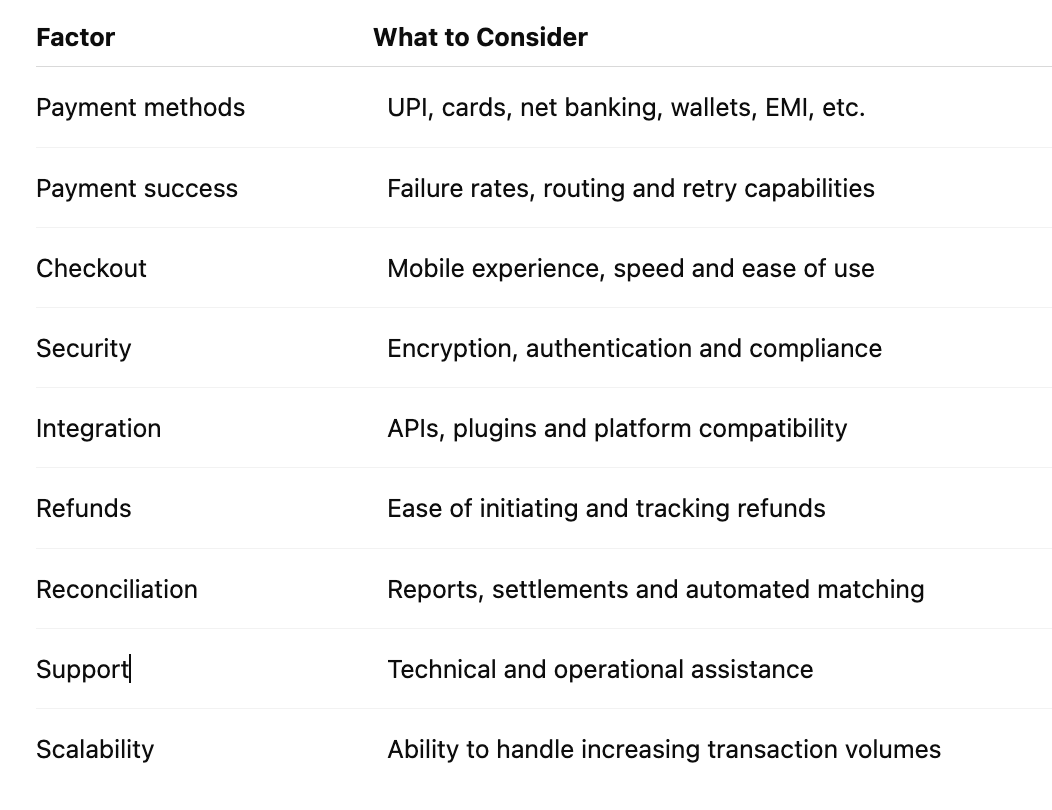
Instead of comparing providers only on transaction fees, consider the total payment experience they can deliver.
A slightly lower processing cost may not be beneficial if frequent payment failures, manual reconciliation, or poor support are affecting your business.
Payment Gateway vs. Payment Aggregator: What’s the Difference?
The terms payment gateway and payment aggregator are often used interchangeably, but they are not exactly the same.
To understand the key differences, features, and use cases, read our detailed guide on Payment Gateway vs. Payment Aggregator
A payment gateway primarily provides the technology that securely transfers payment information between the customer, merchant, and financial institutions.
A payment aggregator generally provides merchants with access to multiple payment methods through a single platform and can handle broader payment acceptance and settlement processes.
For an ecommerce business, the important consideration is understanding which services the provider offers and whether they match your operational and regulatory requirements.
How a Payment Gateway Can Improve Ecommerce Conversions
Payment isn’t just a backend function. It directly affects the customer journey.
A better payment experience can help ecommerce businesses:
◆ Reduce checkout friction
◆ Offer preferred payment methods
◆ Minimize payment failures
◆ Provide faster confirmation
◆ Simplify refunds
◆ Build customer trust
For example, imagine a customer reaches checkout with a ₹5,000 order but their preferred payment method isn’t available. They may leave the website rather than switch to another option.
Providing the right payment choices at the right moment can make the difference between an abandoned cart and a completed purchase.
Final Thoughts
For ecommerce businesses, a payment gateway is more than a way to accept payments. It impacts the checkout experience, payment success, and financial operations.
Choose a solution that offers multiple payment methods, secure and reliable transactions, easy refunds, automated reconciliation, and seamless integration.
As your business grows, a scalable payment gateway can help reduce operational complexity and deliver a smoother customer experience.
Looking for a payment gateway for your ecommerce business? Explore Toucan’s payment solutions or Book a Free Demo to get started.
Frequently Asked Questions
Q1. What is the best payment gateway for ecommerce businesses in India?
A: The best payment gateway depends on your business requirements, including payment methods, transaction volume, customer locations, integration needs, settlement requirements, and payment performance.
Q2. Which payment methods should an Indian ecommerce business offer?
A: Most ecommerce businesses should consider offering UPI, credit and debit cards, net banking, and digital wallets. Depending on the product and average order value, EMI and other payment options may also be useful.
Q3. How does a payment gateway reduce ecommerce payment failures?
A: Payment gateways can use transaction routing, retries, authentication, and connections with multiple payment partners to help improve payment success. Actual performance depends on the gateway, payment method, bank, and transaction.
Q4. Is a payment gateway secure for ecommerce transactions?
A: A reputable payment gateway should use appropriate security and compliance measures to protect payment information and reduce fraud risks. Businesses should review the provider’s security standards before integration.
Q5. Can a payment gateway integrate with an ecommerce website?
A: Yes. Payment gateways commonly provide APIs, SDKs, plugins, or other integration options that allow businesses to connect payments with their websites, mobile applications, and ecommerce platforms.